
Ch.8 - Reactions of Alkenes
Wade - Organic Chemistry 9th Edition
Wade9th EditionOrganic ChemistryISBN: 9780135213728Not the one you use?Change textbook
Chapter 8, Problem 45a

Show how you would synthesize each compound, starting with alkenes or cycloalkenes that contain no more than six carbon atoms. You may use any additional reagents you need.
(a) Chemical structure of a cycloalkene with a cyano group attached, illustrating a radical reaction synthesis pathway.

Verified step by step guidance
1
Step 1: Start with cyclopentene as the alkene substrate. Cyclopentene is a five-membered ring with one double bond, which satisfies the requirement of having no more than six carbon atoms.
Step 2: Perform a hydrohalogenation reaction using HBr to add a bromine atom to the allylic position of cyclopentene. This reaction proceeds via Markovnikov addition, placing the bromine on the more substituted carbon.
Step 3: Convert the brominated intermediate (bromocyclopentane) into a nitrile by performing a nucleophilic substitution reaction (SN2) using sodium cyanide (NaCN). The cyanide ion will replace the bromine atom, forming the desired nitrile group.
Step 4: Ensure the reaction conditions are appropriate for SN2 substitution, such as using a polar aprotic solvent like DMSO to facilitate the reaction.
Step 5: Verify the final product structure, which should be cyclopentyl nitrile (a five-membered ring with a nitrile group attached).

Verified video answer for a similar problem:

This video solution was recommended by our tutors as helpful for the problem above.
Video duration:
1m
Was this helpful?

Key Concepts

Here are the essential concepts you must grasp in order to answer the question correctly.

Alkenes and Cycloalkenes

Alkenes are hydrocarbons that contain at least one carbon-carbon double bond, while cycloalkenes are cyclic compounds with one or more double bonds. These structures are fundamental in organic synthesis as they can undergo various reactions, including addition and elimination, to form more complex molecules. Understanding their reactivity is crucial for designing synthetic pathways.
Recommended video:
Guided course
01:11
How to find the root name for cycloalkanes

Radical Reactions

Radical reactions involve species with unpaired electrons, known as radicals, which can initiate chain reactions leading to the formation of new bonds. These reactions are significant in organic synthesis, particularly for creating functional groups or modifying existing structures. The image suggests a radical pathway, indicating the importance of understanding radical stability and reactivity in synthesis.
Recommended video:
Guided course
03:49
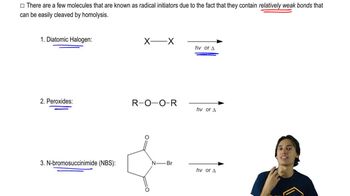
What are Radical Initiators?

Synthesis Strategies

Synthesis strategies in organic chemistry involve planning a series of chemical reactions to construct a desired compound from simpler starting materials. This includes selecting appropriate reagents, reaction conditions, and understanding the mechanisms involved. Effective synthesis requires knowledge of functional group transformations and the ability to predict the outcomes of reactions.
Recommended video:
1:16
Synthesis of Amino Acids: Strecker Synthesis Example 1