
Ch.8 - Reactions of Alkenes
Wade - Organic Chemistry 9th Edition
Wade9th EditionOrganic ChemistryISBN: 9780135213728Not the one you use?Change textbook
Chapter 8, Problem 44

Show what reagents would be needed to synthesize the pheromone of the omnivorous leafroller (OLR) using olefin metathesis to assemble the molecule at the double bond.

Verified step by step guidance
1
Analyze the structure of the OLR pheromone: The molecule contains a long hydrocarbon chain with a double bond (olefin) and an ester functional group at the end. The double bond is the key site for olefin metathesis.
Identify the olefin metathesis strategy: Olefin metathesis involves the exchange of alkene fragments between two molecules. To synthesize the OLR pheromone, divide the molecule into two smaller alkene-containing fragments that can be joined via metathesis.
Determine the two fragments: Based on the structure, one fragment should contain the ester group and part of the hydrocarbon chain, while the other fragment should contain the remaining hydrocarbon chain with an alkene group. For example, fragment 1 could be CH3OCO(CH2)7CH=CH2, and fragment 2 could be CH2=CH(CH2)6CH3.
Select the catalyst for olefin metathesis: Use a ruthenium-based Grubbs catalyst, which is commonly employed for olefin metathesis reactions. This catalyst facilitates the formation of the desired double bond while minimizing side reactions.
Perform the reaction: Combine the two fragments in the presence of the Grubbs catalyst under appropriate reaction conditions (e.g., solvent, temperature). The catalyst will mediate the metathesis reaction, forming the desired OLR pheromone with the cis and trans isomers of the double bond.

Verified video answer for a similar problem:

This video solution was recommended by our tutors as helpful for the problem above.
Video duration:
7m
Was this helpful?

Key Concepts

Here are the essential concepts you must grasp in order to answer the question correctly.

Olefin Metathesis

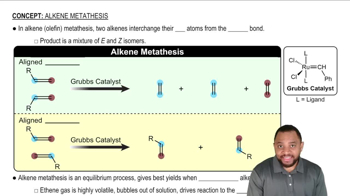
Olefin metathesis is a chemical reaction that involves the exchange of alkene fragments to form new alkenes. This reaction is facilitated by catalysts, typically based on transition metals, which allow for the breaking and forming of carbon-carbon double bonds. Understanding this concept is crucial for synthesizing complex molecules, such as pheromones, by rearranging existing alkenes into desired structures.
Recommended video:
2:09
Alkene Metathesis Concept 1

Pheromone Structure

Pheromones are chemical signals used for communication between individuals of the same species, often influencing behavior such as mating. The structure of the OLR pheromone, as depicted in the image, includes multiple double bonds and functional groups, which are essential for its biological activity. Recognizing the specific features of pheromones helps in designing synthetic pathways to replicate their structures.
Recommended video:
Guided course
03:04
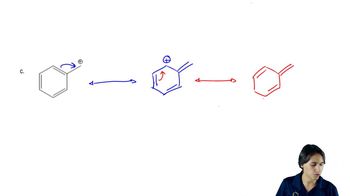
Drawing Resonance Structures

Reagents for Synthesis

The choice of reagents is critical in organic synthesis, particularly in reactions like olefin metathesis. Common reagents include Grubbs or Hoveyda catalysts, which facilitate the metathesis process. Additionally, protecting groups may be required for functional groups to prevent unwanted reactions during synthesis. Understanding the role of these reagents is essential for successfully assembling complex organic molecules.
Recommended video:
1:16
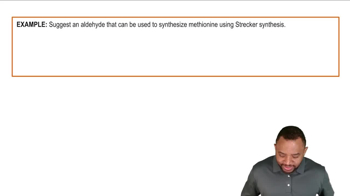
Synthesis of Amino Acids: Strecker Synthesis Example 1