Ch.8 - Reactions of Alkenes
Wade - Organic Chemistry 9th Edition
Wade9th EditionOrganic ChemistryISBN: 9780135213728Not the one you use?Change textbook
Chapter 8, Problem 51h

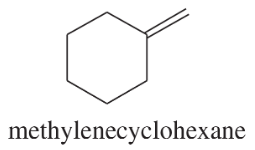
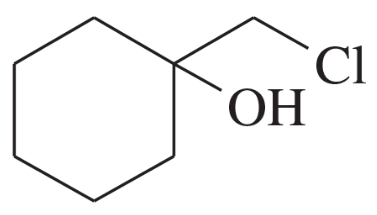
Show how you would synthesize each compound using methylenecyclohexane as your starting material.

(h)

Verified step by step guidance
1
Step 1: Begin with methylenecyclohexane as the starting material. This compound contains a cyclohexane ring with a methylene group (CH2) attached via a double bond.
Step 2: Perform a hydroboration-oxidation reaction to convert the double bond into an alcohol group. Use BH3 (borane) followed by H2O2 (hydrogen peroxide) and NaOH (sodium hydroxide). This will yield cyclohexanol, where the OH group is added to the less substituted carbon of the double bond.
Step 3: To introduce the chlorine atom, perform a substitution reaction. React cyclohexanol with thionyl chloride (SOCl2) or phosphorus trichloride (PCl3) to replace the hydroxyl group with a chlorine atom, forming cyclohexyl chloride.
Step 4: To add the hydroxyl group back to the molecule, perform a nucleophilic substitution reaction. React cyclohexyl chloride with aqueous NaOH or KOH under controlled conditions to form the desired compound with both OH and Cl groups.
Step 5: Ensure the final product matches the target compound structure, with the hydroxyl group and chlorine atom attached to adjacent carbons on the cyclohexane ring.

Verified video answer for a similar problem:

This video solution was recommended by our tutors as helpful for the problem above.
Video duration:
1m
Was this helpful?

Key Concepts

Here are the essential concepts you must grasp in order to answer the question correctly.

Electrophilic Addition Reactions

Electrophilic addition reactions involve the addition of electrophiles to nucleophilic sites in alkenes. In the case of methylenecyclohexane, the double bond acts as a nucleophile, allowing for the addition of halogens or other electrophiles. This is a fundamental reaction in organic chemistry that can lead to the formation of various functional groups, such as halohydrins.
Recommended video:
Guided course
05:39
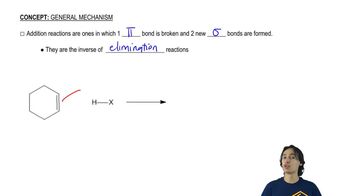
Features of Addition Mechanisms.

Halohydrin Formation

Halohydrins are compounds that contain both a halogen and a hydroxyl group on adjacent carbon atoms. The synthesis of halohydrins from alkenes typically occurs through the reaction of alkenes with halogens in the presence of water. Understanding this process is crucial for synthesizing the halohydrin compound shown in the question, as it illustrates how functional groups can be introduced to a carbon framework.
Recommended video:
Guided course
01:44
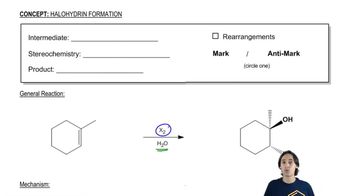
General properties of halohydrin formation.

Regioselectivity and Stereochemistry

Regioselectivity refers to the preference of a chemical reaction to yield one structural isomer over others, while stereochemistry deals with the spatial arrangement of atoms in molecules. In the synthesis of halohydrins from methylenecyclohexane, it is important to consider which carbon atoms the halogen and hydroxyl group will attach to, as well as the potential for different stereoisomers to form, impacting the final product's properties.
Recommended video:
1:38
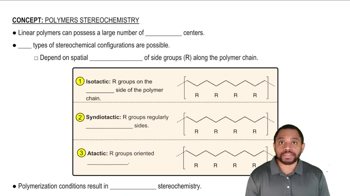
Polymer Stereochemistry Concept 1