Ch.8 - Reactions of Alkenes
Wade - Organic Chemistry 9th Edition
Wade9th EditionOrganic ChemistryISBN: 9780135213728Not the one you use?Change textbook
Chapter 8, Problem 51e

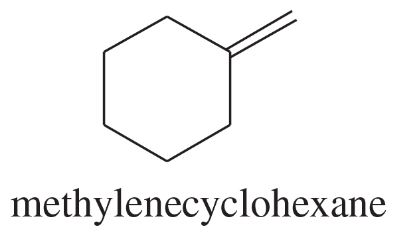
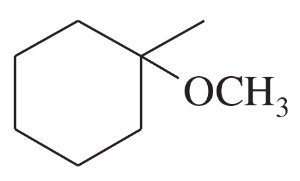
Show how you would synthesize each compound using methylenecyclohexane as your starting material.

(e)

Verified step by step guidance
1
Step 1: Begin with methylenecyclohexane as the starting material. This compound contains a cyclohexane ring with a methylene group (CH2) attached via a double bond.
Step 2: Perform an electrophilic addition reaction using methanol (CH3OH) in the presence of an acid catalyst, such as H2SO4. The double bond in methylenecyclohexane will act as a nucleophile and react with the proton from the acid catalyst.
Step 3: The protonation of the double bond will generate a carbocation intermediate. Since the double bond is terminal, the carbocation will form at the more stable secondary position on the cyclohexane ring.
Step 4: Methanol (CH3OH) will act as a nucleophile and attack the carbocation, leading to the formation of a new bond between the oxygen atom of methanol and the carbon atom of the carbocation.
Step 5: Finally, deprotonation of the oxygen atom in the methanol group will occur, resulting in the formation of the desired product: cyclohexane with a methoxy group (OCH3) attached to the former double bond position.

Verified video answer for a similar problem:

This video solution was recommended by our tutors as helpful for the problem above.
Video duration:
2m
Was this helpful?

Key Concepts

Here are the essential concepts you must grasp in order to answer the question correctly.

Synthesis of Ethers

Ethers are organic compounds characterized by an oxygen atom connected to two alkyl or aryl groups. The synthesis of ethers can be achieved through various methods, including the Williamson ether synthesis, which involves the nucleophilic substitution of an alkoxide ion with a primary alkyl halide. Understanding this process is crucial for synthesizing ethers from methylenecyclohexane.
Recommended video:
Guided course
03:50
The Mechanism of Williamson Ether Synthesis.

Reactivity of Alkenes

Methylenecyclohexane contains a double bond, making it an alkene. Alkenes are reactive due to the presence of the π bond, which can undergo various reactions such as electrophilic addition, oxidation, and polymerization. Recognizing the reactivity of alkenes is essential for planning synthetic routes that involve the transformation of methylenecyclohexane into other compounds.
Recommended video:
2:09
Alkene Metathesis Concept 1

Functional Group Transformation

Functional group transformation refers to the process of converting one functional group into another through chemical reactions. In the context of synthesizing compounds from methylenecyclohexane, understanding how to manipulate functional groups, such as converting alkenes to alcohols or ethers, is vital for achieving the desired product. This concept is foundational in organic synthesis.
Recommended video:
Guided course
02:36
Identifying Functional Groups