
Textbook Question
In the presence of a small amount of bromine, cyclohexene undergoes the following light-promoted reaction:
d. Explain why cyclohexene reacts with bromine much faster than cyclohexane, which must be heated to react.
1263
views

 Verified step by step guidance
 10:49
10:49
 05:58
05:58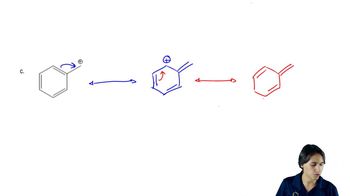 03:04
03:04In the presence of a small amount of bromine, cyclohexene undergoes the following light-promoted reaction:
d. Explain why cyclohexene reacts with bromine much faster than cyclohexane, which must be heated to react.
Propose a mechanism involving a hydride shift or an alkyl shift for each solvolysis reaction. Explain how each rearrangement forms a more stable intermediate.
Hint: Most rearrangements convert 2° (or incipient 1°) carbocations to 3° or resonance-stabilized carbocations.
(b)
Choose the member of each pair that will react faster by the SN1 mechanism.
c. n-propyl bromide or allyl bromide
d. 1-bromo-2,2-dimethylpropane or 2-bromopropane
Give the SN1 mechanism for the formation of 2-ethoxy-3-methylbutane, the unrearranged product in this reaction.
3-Bromocyclohexene is a secondary halide. It undergoes SN1 substitution about as fast as most tertiary halides. Use resonance structures to explain this enhanced reactivity.
Choose the member of each pair that will react faster by the SN1 mechanism.
e. 2-iodo-2-methylbutane or tert-butyl chloride
f. 2-bromo-2-methylbutane or ethyl iodide