Ch.6 - Alkyl Halides; Nucleophilic Substitution
Wade - Organic Chemistry 9th Edition
Wade9th EditionOrganic ChemistryISBN: 9780135213728Not the one you use?Change textbook
Chapter 6, Problem 23e,f

Choose the member of each pair that will react faster by the SN1 mechanism.
e. 2-iodo-2-methylbutane or tert-butyl chloride
f. 2-bromo-2-methylbutane or ethyl iodide

Verified step by step guidance
1
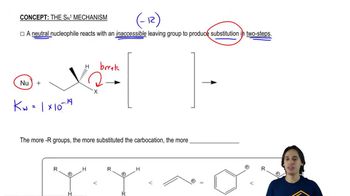
Step 1: Understand the SN1 mechanism. The SN1 reaction proceeds via a two-step process: (1) formation of a carbocation intermediate after the leaving group departs, and (2) nucleophilic attack on the carbocation. The rate of the reaction depends on the stability of the carbocation formed and the nature of the leaving group.
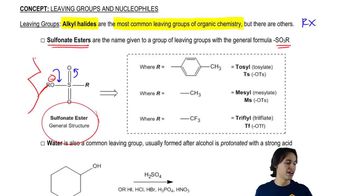
Step 2: Compare the leaving groups in each pair. The leaving group ability is determined by how easily it can depart and stabilize itself. Iodide (I⁻) is a better leaving group than bromide (Br⁻) or chloride (Cl⁻) because it is larger and more polarizable.
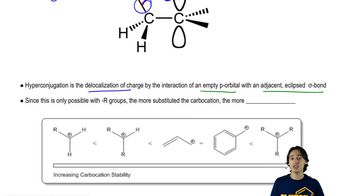
Step 3: Evaluate the carbocation stability for each compound. Carbocation stability increases in the order: primary < secondary < tertiary. Tertiary carbocations are the most stable due to hyperconjugation and inductive effects from surrounding alkyl groups.
Step 4: Analyze pair (e): 2-iodo-2-methylbutane vs. tert-butyl chloride. Both compounds form tertiary carbocations upon losing their leaving groups, but iodide is a better leaving group than chloride, making 2-iodo-2-methylbutane react faster via the SN1 mechanism.
Step 5: Analyze pair (f): 2-bromo-2-methylbutane vs. ethyl iodide. 2-bromo-2-methylbutane forms a tertiary carbocation, while ethyl iodide forms a primary carbocation. Since tertiary carbocations are more stable, 2-bromo-2-methylbutane will react faster via the SN1 mechanism despite bromide being a slightly weaker leaving group than iodide.

Verified video answer for a similar problem:

This video solution was recommended by our tutors as helpful for the problem above.
Video duration:
2m
Was this helpful?

Key Concepts

Here are the essential concepts you must grasp in order to answer the question correctly.

SN1 Mechanism

The SN1 mechanism is a type of nucleophilic substitution reaction that involves two main steps: the formation of a carbocation intermediate and the subsequent attack by a nucleophile. The rate of the reaction depends primarily on the stability of the carbocation formed, which is influenced by factors such as the degree of substitution and the presence of electron-donating groups.
Recommended video:
Guided course
10:49
Drawing the SN1 Mechanism

Carbocation Stability

Carbocation stability is a crucial factor in determining the rate of SN1 reactions. Tertiary carbocations are more stable than secondary or primary ones due to hyperconjugation and inductive effects from surrounding alkyl groups. Therefore, substrates that can form more stable carbocations will react faster via the SN1 mechanism.
Recommended video:
Guided course
05:58
Determining Carbocation Stability

Leaving Groups

The quality of the leaving group significantly affects the rate of SN1 reactions. Good leaving groups, such as iodide and bromide, can stabilize the transition state and facilitate the formation of the carbocation. In general, the better the leaving group, the faster the reaction will proceed, as it can depart more easily during the first step of the SN1 mechanism.
Recommended video:
Guided course
07:22
The 3 important leaving groups to know.