
Ch.6 - Alkyl Halides; Nucleophilic Substitution
Wade - Organic Chemistry 9th Edition
Wade9th EditionOrganic ChemistryISBN: 9780135213728Not the one you use?Change textbook
Chapter 6, Problem 5c,d

For each pair of compounds, predict which one has the higher molecular dipole moment, and explain your reasoning.
c. cis-2,3-dibromobut-2-ene or trans-2,3-dibromobut-2-ene
d. cis-1,2-dichlorocyclobutane or trans-1,3-dichlorocyclobutane

Verified step by step guidance
1
Step 1: Understand the concept of molecular dipole moment. The dipole moment is a measure of the separation of positive and negative charges in a molecule. It depends on both the magnitude of the individual bond dipoles and their spatial arrangement.
Step 2: Analyze the structure of cis-2,3-dibromobut-2-ene. In the cis isomer, the bromine atoms are on the same side of the double bond, which can lead to a net dipole moment as the bond dipoles do not cancel out completely.
Step 3: Analyze the structure of trans-2,3-dibromobut-2-ene. In the trans isomer, the bromine atoms are on opposite sides of the double bond, which often results in the bond dipoles canceling each other out, leading to a lower or zero net dipole moment.
Step 4: Compare the dipole moments of cis-1,2-dichlorocyclobutane and trans-1,3-dichlorocyclobutane. In the cis isomer, the chlorine atoms are on the same side of the cyclobutane ring, which can result in a net dipole moment. In the trans isomer, the chlorine atoms are on opposite sides, which may lead to cancellation of dipole moments.
Step 5: Conclude that the molecular geometry and the relative positions of the substituents (cis vs. trans) significantly affect the net dipole moment. Generally, cis isomers tend to have higher dipole moments than their trans counterparts due to less cancellation of bond dipoles.

Verified video answer for a similar problem:

This video solution was recommended by our tutors as helpful for the problem above.
Video duration:
5m
Was this helpful?

Key Concepts

Here are the essential concepts you must grasp in order to answer the question correctly.

Molecular Dipole Moment

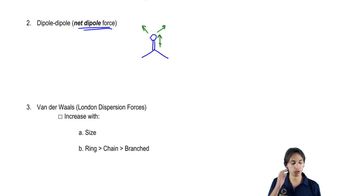
The molecular dipole moment is a measure of the overall polarity of a molecule, determined by the vector sum of all individual bond dipoles. It depends on both the magnitude of the bond dipoles and their spatial arrangement. Molecules with symmetrical arrangements of polar bonds may have a net dipole moment of zero, while asymmetrical arrangements can result in a higher dipole moment.
Recommended video:
Guided course
01:46
How dipole-dipole forces work.

Cis-Trans Isomerism

Cis-trans isomerism, a type of stereoisomerism, occurs in compounds with restricted rotation around a bond, such as double bonds or in cyclic structures. In cis isomers, similar or identical groups are on the same side, leading to potential dipole moments due to asymmetry. In trans isomers, these groups are on opposite sides, often resulting in cancellation of dipole moments due to symmetry.
Recommended video:
Guided course
00:44
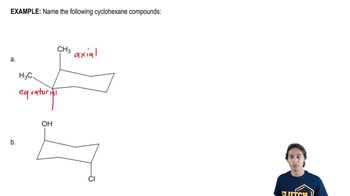
Is the following cyclohexane cis or trans?

Effect of Substituents on Cycloalkanes

In cycloalkanes, the spatial arrangement of substituents significantly affects the molecule's dipole moment. Substituents in a cis configuration can create a net dipole moment due to their additive effect, while in a trans configuration, the dipoles may cancel out. The position and type of substituents, along with the ring strain, influence the overall molecular polarity.
Recommended video:
2:02
Directing Effects in Substituted Pyrroles, Furans, and Thiophenes Concept 1
Related Practice
Textbook Question

a. Propose a mechanism for the following reaction:

b. Use the bond-dissociation enthalpies given in Table 4-2 (page 167) to calculate the value of ΔH° for each step shown in your mechanism. (The BDE for CH2=CHCH2―Br is about 280 kJ/mol, or 67 kcal/mol.) Calculate the overall value of ΔH° for the reaction. Are these values consistent with a rapid free-radical chain reaction?

2163
views
Textbook Question
The reaction of an amine with an alkyl halide gives an ammonium salt.R3N amine + R'—X alkyl halide —> R3(N+)—R' X- ammonium salt The rate of this SN2 reaction is sensitive to the polarity of the solvent. 1. Draw an energy diagram for this reaction in a nonpolar solvent and another in a polar solvent. 2. Consider the nature of the transition state, and explain why this reaction should be sensitive to the polarity of the solvent. 3. Predict whether it will be faster or slower in a more polar solvent.

2761
views
Textbook Question
The reaction of an amine with an alkyl halide gives an ammonium salt.R3N amine + R'—X alkyl halide —> R3(N+)—R' X- ammonium salt The rate of this SN2 reaction is sensitive to the polarity of the solvent. 1. Draw an energy diagram for this reaction in a nonpolar solvent and another in a polar solvent. 2. Consider the nature of the transition state, and explain why this reaction should be sensitive to the polarity of the solvent. 3. Predict whether it will be faster or slower in a more polar solvent.
523
views
Textbook Question

Kepone, aldrin, and chlordane are synthesized from hexachlorocyclopentadiene and other five-membered-ring compounds. Show how these three pesticides are composed of two five-membered rings.

979
views
Textbook Question

For each pair of compounds, predict which one has the higher molecular dipole moment, and explain your reasoning.

a. ethyl chloride or ethyl iodide

b. 1-bromopropane or cyclopropane

1684
views
Textbook Question

For each of the following compounds,

1. give the IUPAC name.

2. give the common name (if possible).

3. classify the compound as a methyl, primary, secondary, or tertiary halide.

(f)

678
views