
Ch.6 - Alkyl Halides; Nucleophilic Substitution
Wade - Organic Chemistry 9th Edition
Wade9th EditionOrganic ChemistryISBN: 9780135213728Not the one you use?Change textbook
Chapter 6, Problem 5a,b

For each pair of compounds, predict which one has the higher molecular dipole moment, and explain your reasoning.
a. ethyl chloride or ethyl iodide
b. 1-bromopropane or cyclopropane

Verified step by step guidance
1
Step 1: Understand the concept of molecular dipole moment. The dipole moment is a measure of the separation of positive and negative charges in a molecule. It depends on the electronegativity of atoms and the geometry of the molecule.
Step 2: Analyze the electronegativity of the halogens involved. Chlorine is more electronegative than iodine, which means it will create a larger dipole moment when bonded to carbon. Compare ethyl chloride (C2H5Cl) and ethyl iodide (C2H5I) based on this property.
Step 3: Consider the molecular geometry and bond polarity for ethyl chloride and ethyl iodide. The C-Cl bond is more polar than the C-I bond due to the higher electronegativity of chlorine, leading to a higher dipole moment for ethyl chloride.
Step 4: For 1-bromopropane (C3H7Br) and cyclopropane (C3H6), evaluate the presence of polar bonds. 1-bromopropane has a polar C-Br bond, while cyclopropane is a non-polar molecule due to its symmetrical ring structure.
Step 5: Conclude that 1-bromopropane will have a higher dipole moment than cyclopropane because it contains a polar bond, whereas cyclopropane's symmetrical structure results in no net dipole moment.

Verified video answer for a similar problem:

This video solution was recommended by our tutors as helpful for the problem above.
Video duration:
6m
Was this helpful?

Key Concepts

Here are the essential concepts you must grasp in order to answer the question correctly.

Molecular Dipole Moment

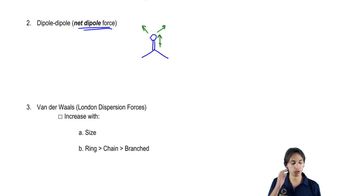
The molecular dipole moment is a measure of the overall polarity of a molecule, determined by the vector sum of all individual bond dipoles. It depends on both the difference in electronegativity between bonded atoms and the geometry of the molecule. A higher dipole moment indicates a more polar molecule, which affects properties like solubility and boiling point.
Recommended video:
Guided course
01:46
How dipole-dipole forces work.

Electronegativity

Electronegativity is the tendency of an atom to attract electrons in a chemical bond. In a molecule, the atom with higher electronegativity will attract shared electrons more strongly, creating a dipole. The difference in electronegativity between atoms in a bond contributes to the bond's polarity, influencing the overall dipole moment of the molecule.
Recommended video:
Guided course
1:47
Electronegativity

Molecular Geometry

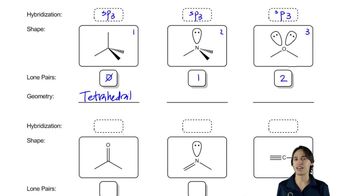
Molecular geometry refers to the three-dimensional arrangement of atoms in a molecule. It plays a crucial role in determining the dipole moment, as the spatial orientation of polar bonds can either enhance or cancel out the overall dipole. For example, linear or symmetrical geometries may result in a net dipole moment of zero, even if individual bonds are polar.
Recommended video:
Guided course
07:44
Molecular Geometry Explained.
Related Practice
Textbook Question

For each pair of compounds, predict which one has the higher molecular dipole moment, and explain your reasoning.

c. cis-2,3-dibromobut-2-ene or trans-2,3-dibromobut-2-ene

d. cis-1,2-dichlorocyclobutane or trans-1,3-dichlorocyclobutane

1395
views
Textbook Question
The reaction of an amine with an alkyl halide gives an ammonium salt.R3N amine + R'—X alkyl halide —> R3(N+)—R' X- ammonium salt The rate of this SN2 reaction is sensitive to the polarity of the solvent. 1. Draw an energy diagram for this reaction in a nonpolar solvent and another in a polar solvent. 2. Consider the nature of the transition state, and explain why this reaction should be sensitive to the polarity of the solvent. 3. Predict whether it will be faster or slower in a more polar solvent.

2761
views
Textbook Question
The reaction of an amine with an alkyl halide gives an ammonium salt.R3N amine + R'—X alkyl halide —> R3(N+)—R' X- ammonium salt The rate of this SN2 reaction is sensitive to the polarity of the solvent. 1. Draw an energy diagram for this reaction in a nonpolar solvent and another in a polar solvent. 2. Consider the nature of the transition state, and explain why this reaction should be sensitive to the polarity of the solvent. 3. Predict whether it will be faster or slower in a more polar solvent.
523
views
Textbook Question

Kepone, aldrin, and chlordane are synthesized from hexachlorocyclopentadiene and other five-membered-ring compounds. Show how these three pesticides are composed of two five-membered rings.

979
views
Textbook Question

For each of the following compounds,

1. give the IUPAC name.

2. give the common name (if possible).

3. classify the compound as a methyl, primary, secondary, or tertiary halide.

e.

921
views
Textbook Question

For each of the following compounds,

1. give the IUPAC name.

2. give the common name (if possible).

3. classify the compound as a methyl, primary, secondary, or tertiary halide.

(f)

678
views