
Ch.6 - Alkyl Halides; Nucleophilic Substitution
Wade - Organic Chemistry 9th Edition
Wade9th EditionOrganic ChemistryISBN: 9780135213728Not the one you use?Change textbook
Chapter 6, Problem 27c

For each reaction, give the expected substitution product, and predict whether the ­mechanism will be predominantly first order (SN1) or second order (SN2).
c. 1-iodo-1-methylcyclohexane + ethanol

Verified step by step guidance
1
Step 1: Analyze the substrate structure. The substrate is 1-iodo-1-methylcyclohexane, which is a tertiary (3°) halide because the carbon bonded to the iodine is also attached to three other carbons. This structural feature is important for determining the reaction mechanism.
Step 2: Consider the nucleophile and solvent. Ethanol is a weak nucleophile and a polar protic solvent. Weak nucleophiles and polar protic solvents favor the SN1 mechanism because they stabilize the carbocation intermediate formed during the reaction.
Step 3: Evaluate the likelihood of SN2. SN2 reactions are unlikely with tertiary halides due to steric hindrance. The bulky groups around the carbon bonded to iodine prevent the nucleophile from attacking directly in a single step.
Step 4: Predict the mechanism. Based on the substrate (tertiary halide) and the weak nucleophile (ethanol), the reaction is expected to proceed via the SN1 mechanism. This involves a two-step process: (1) the leaving group (iodine) departs, forming a carbocation intermediate, and (2) the nucleophile (ethanol) attacks the carbocation.
Step 5: Determine the substitution product. In the SN1 mechanism, the nucleophile (ethanol) will attach to the carbocation intermediate, forming the substitution product. Since the carbocation is planar, the product may exhibit racemization if the carbon is chiral.

Verified video answer for a similar problem:

This video solution was recommended by our tutors as helpful for the problem above.
Video duration:
7m
Was this helpful?

Key Concepts

Here are the essential concepts you must grasp in order to answer the question correctly.

Nucleophilicity

Nucleophilicity refers to the strength and reactivity of a nucleophile, which is a species that donates an electron pair to form a chemical bond. Strong nucleophiles, such as alkoxides or amines, are more likely to participate in bimolecular nucleophilic substitution (SN2) reactions, while weak nucleophiles, like water or alcohols, tend to favor unimolecular nucleophilic substitution (SN1) mechanisms.
Recommended video:
Guided course
08:27
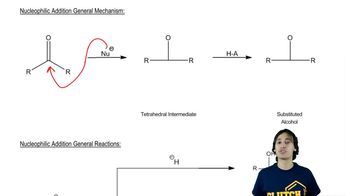
Nucleophilic Addition

SN1 vs. SN2 Mechanisms

SN1 and SN2 are two distinct mechanisms of nucleophilic substitution reactions. SN1 is a first-order reaction that involves the formation of a carbocation intermediate, typically favored by tertiary substrates and weak nucleophiles. In contrast, SN2 is a second-order reaction that occurs in a single concerted step, requiring strong nucleophiles and is generally favored by primary substrates due to steric accessibility.
Recommended video:
Guided course
10:49
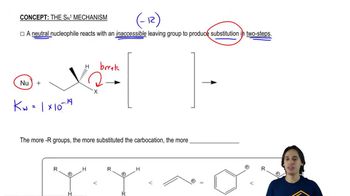
Drawing the SN1 Mechanism

Substrate Structure

The structure of the substrate plays a crucial role in determining the mechanism of nucleophilic substitution. Tertiary (3°) substrates are more likely to undergo SN1 reactions due to the stability of the resulting carbocation, while primary (1°) substrates favor SN2 reactions. Additionally, resonance stabilization can influence the reactivity of certain substrates, making them more amenable to SN1 pathways even if they are primary.
Recommended video:
Guided course
03:04
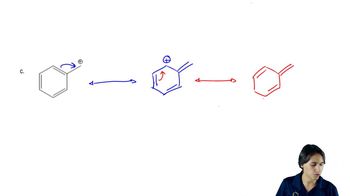
Drawing Resonance Structures
Related Practice
Textbook Question

For each reaction, give the expected substitution product, and predict whether the ­mechanism will be predominantly first order (SN1) or second order (SN2).

a. 2-chloro-2-methylbutane + CH3COOH

b. isobutylbromide + sodium methoxide

819
views
Textbook Question

Under certain conditions, when (R)-2-bromobutane is heated with water, the SN1 substitution proceeds twice as fast as the SN2. Calculate the e.e. and the specific rotation expected for the product. The specific rotation of (R)-butan-2-ol is −13.5°. Assume that the SN1 gives equal amounts of the two enantiomers.

1242
views
Textbook Question

For each reaction, give the expected substitution product, and predict whether the ­mechanism will be predominantly first order (SN1) or second order (SN2).

d. cyclohexylbromide + methanol

e. cyclohexylbromide + sodium ethoxide

1574
views
Textbook Question

A reluctant first-order substrate can be forced to ionize by adding some silver nitrate (one of the few soluble silver salts) to the reaction. Silver ion reacts with the halogen to form a silver halide (a highly exothermic reaction), generating the cation of the alkyl group.

Give mechanisms for the following silver-promoted rearrangements.

(a)

1853
views
Textbook Question

Propose a mechanism involving a hydride shift or an alkyl shift for each solvolysis reaction. Explain how each rearrangement forms a more stable intermediate.

Hint: Most rearrangements convert 2° (or incipient 1°) carbocations to 3° or resonance-stabilized carbocations.

(c)

754
views
Textbook Question

Propose a mechanism involving a hydride shift or an alkyl shift for each solvolysis reaction. Explain how each rearrangement forms a more stable intermediate.

Hint: Most rearrangements convert 2° (or incipient 1°) carbocations to 3° or resonance-stabilized carbocations.

(d)

724
views