Ch.6 - Alkyl Halides; Nucleophilic Substitution
Wade - Organic Chemistry 9th Edition
Wade9th EditionOrganic ChemistryISBN: 9780135213728Not the one you use?Change textbook
Chapter 6, Problem 26c

Propose a mechanism involving a hydride shift or an alkyl shift for each solvolysis reaction. Explain how each rearrangement forms a more stable intermediate.
Hint: Most rearrangements convert 2° (or incipient 1°) carbocations to 3° or resonance-stabilized carbocations.
(c) Chemical reaction diagram showing the SN1 mechanism with reactants and products, including hydride or alkyl shifts.

Verified step by step guidance
1
Step 1: Begin by identifying the leaving group in the substrate. In this case, the iodine atom (I) attached to the cyclohexene ring is the leaving group. Under solvolysis conditions, the bond between the carbon and iodine breaks, forming a carbocation intermediate.
Step 2: Analyze the stability of the initially formed carbocation. The carbocation formed directly after the iodine leaves is a secondary carbocation. Secondary carbocations are less stable than tertiary carbocations or resonance-stabilized carbocations.
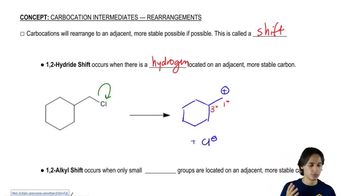
Step 3: Propose a rearrangement mechanism to stabilize the carbocation. A hydride shift or an alkyl shift can occur to convert the secondary carbocation into a more stable tertiary carbocation. In this case, a hydride shift from an adjacent carbon atom can occur, moving a hydrogen atom along with its bonding electrons to the carbocation center.
Step 4: After the hydride shift, the carbocation is now tertiary, which is more stable due to increased hyperconjugation and inductive effects. This rearranged carbocation is the key intermediate for the subsequent reaction.
Step 5: The rearranged carbocation reacts with acetic acid (CH3COOH) to form the final product. The nucleophilic oxygen atom in acetic acid attacks the carbocation, leading to the formation of the ester products shown in the reaction.

Verified video answer for a similar problem:

This video solution was recommended by our tutors as helpful for the problem above.
Video duration:
3m
Was this helpful?

Key Concepts

Here are the essential concepts you must grasp in order to answer the question correctly.

Carbocation Stability

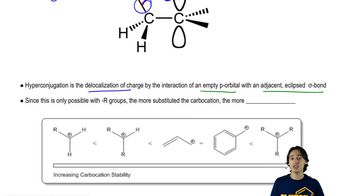
Carbocations are positively charged carbon species that can undergo rearrangements to achieve greater stability. The stability of carbocations increases in the order of primary < secondary < tertiary due to hyperconjugation and inductive effects from adjacent alkyl groups. In solvolysis reactions, rearrangements often convert less stable carbocations into more stable ones, such as transforming a secondary carbocation into a tertiary one.
Recommended video:
Guided course
05:58
Determining Carbocation Stability

Hydride and Alkyl Shifts

Hydride shifts involve the migration of a hydrogen atom with its bonding electrons from one carbon to an adjacent positively charged carbon, while alkyl shifts involve the movement of an alkyl group. These shifts are key mechanisms in carbocation rearrangements, allowing the molecule to form a more stable carbocation intermediate. Such shifts are often driven by the need to minimize the energy of the transition state and stabilize the resulting carbocation.
Recommended video:
Guided course
03:34
Hydride Shift

SN1 Mechanism

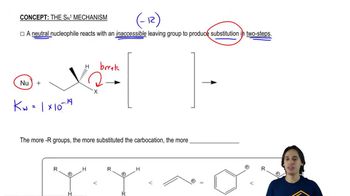
The SN1 mechanism is a type of nucleophilic substitution reaction characterized by a two-step process: the formation of a carbocation intermediate followed by nucleophilic attack. The first step is the rate-determining step, where the leaving group departs, forming a carbocation. The stability of this intermediate is crucial, as more stable carbocations lead to faster reaction rates and a higher likelihood of rearrangements, such as hydride or alkyl shifts, to achieve stability.
Recommended video:
Guided course
10:49
Drawing the SN1 Mechanism