Ch.6 - Alkyl Halides; Nucleophilic Substitution
Wade - Organic Chemistry 9th Edition
Wade9th EditionOrganic ChemistryISBN: 9780135213728Not the one you use?Change textbook
Chapter 6, Problem 45e,f

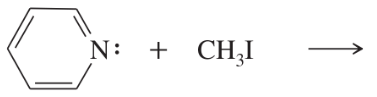
Predict the products of the following SN2 reactions.
(e)
(f)

Verified step by step guidance
1
Step 1: Understand the SN2 reaction mechanism. SN2 reactions involve a single-step nucleophilic substitution where the nucleophile attacks the electrophilic carbon, displacing the leaving group. The reaction proceeds with inversion of configuration at the carbon center.
Step 2: For part (e), identify the nucleophile and electrophile. The nucleophile is pyridine (C5H5N), which has a lone pair on nitrogen, and the electrophile is methyl iodide (CH3I). The nitrogen in pyridine will attack the methyl carbon in CH3I, displacing the iodide ion (I⁻).
Step 3: Predict the product for part (e). The nitrogen in pyridine will form a bond with the methyl group, resulting in a methylated pyridinium ion (C5H5N-CH3⁺). The iodide ion (I⁻) will be the counterion.
Step 4: For part (f), identify the nucleophile and electrophile. The nucleophile is ammonia (NH3), and the electrophile is the alkyl bromide ((CH3)3C-CH2CH2Br). Ammonia will attack the electrophilic carbon bonded to bromine, displacing the bromide ion (Br⁻).
Step 5: Predict the product for part (f). The primary product will be a substituted amine ((CH3)3C-CH2CH2-NH2). Since excess ammonia is present, further substitution reactions may occur, leading to secondary and tertiary amines, as well as quaternary ammonium salts.

Verified video answer for a similar problem:

This video solution was recommended by our tutors as helpful for the problem above.
Video duration:
6m
Was this helpful?

Key Concepts

Here are the essential concepts you must grasp in order to answer the question correctly.

S<sub>N</sub>2 Mechanism

The S<sub>N</sub>2 mechanism is a type of nucleophilic substitution reaction where a nucleophile attacks an electrophile, resulting in the simultaneous displacement of a leaving group. This reaction occurs in a single concerted step, leading to the formation of a new bond while breaking an existing one. The reaction rate depends on the concentration of both the nucleophile and the substrate, making it bimolecular.
Recommended video:
Guided course
05:29
Creating Ribonucleosides

Nucleophiles

Nucleophiles are species that donate an electron pair to form a chemical bond in a reaction. They are typically negatively charged or neutral molecules with lone pairs of electrons. In the context of S<sub>N</sub>2 reactions, a strong nucleophile is essential for effectively attacking the electrophile, which in this case is the carbon atom bonded to the leaving group (iodine in CH<sub>3</sub>I).
Recommended video:
Guided course
08:27
Nucleophilic Addition

Leaving Groups

Leaving groups are atoms or groups of atoms that can depart from the parent molecule during a chemical reaction, taking with them an electron pair. A good leaving group is typically stable after departure and can stabilize the negative charge, such as iodide (I<sup>-</sup>) in the case of S<sub>N</sub>2 reactions. The ability of a leaving group to leave affects the reaction's rate and mechanism.
Recommended video:
Guided course
07:22
The 3 important leaving groups to know.