Ch.6 - Alkyl Halides; Nucleophilic Substitution
Wade - Organic Chemistry 9th Edition
Wade9th EditionOrganic ChemistryISBN: 9780135213728Not the one you use?Change textbook
Chapter 6, Problem 46 a

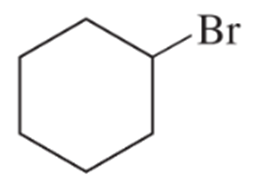
Using cyclohexane as one of your starting materials, show how you would synthesize the following compounds.
(a)

Verified step by step guidance
1
Step 1: Begin with cyclohexane as the starting material. Cyclohexane is a saturated hydrocarbon with the molecular formula C6H12.
Step 2: To introduce a bromine atom onto the cyclohexane ring, perform a free radical halogenation reaction. This reaction typically requires the presence of bromine (Br2) and a source of UV light or heat to initiate the formation of bromine radicals.
Step 3: The bromine radicals generated will abstract a hydrogen atom from cyclohexane, forming a cyclohexyl radical. This radical will then react with another bromine molecule to form bromocyclohexane.
Step 4: Ensure that the reaction conditions are controlled to favor monobromination rather than polybromination. Excess bromine or prolonged reaction times can lead to multiple bromine atoms being added to the cyclohexane ring.
Step 5: Isolate and purify the bromocyclohexane product using techniques such as distillation or recrystallization, depending on the physical properties of the compound.

Verified video answer for a similar problem:

This video solution was recommended by our tutors as helpful for the problem above.
Video duration:
1m
Was this helpful?

Key Concepts

Here are the essential concepts you must grasp in order to answer the question correctly.

Free Radical Halogenation

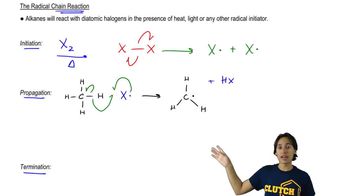
Free radical halogenation is a reaction where alkanes react with halogens (like bromine) in the presence of heat or light to form alkyl halides. The process involves the generation of free radicals, which are highly reactive species with unpaired electrons. In the case of cyclohexane, bromine can abstract a hydrogen atom, leading to the formation of bromocyclohexane.
Recommended video:
Guided course
12:11
Radical Chain Reaction Mechanism.

Cyclohexane Structure

Cyclohexane is a six-membered carbon ring with the molecular formula C6H12. It is a saturated hydrocarbon, meaning it contains only single bonds between carbon atoms. The structure allows for various conformations, such as chair and boat forms, which influence its reactivity and interactions with other reagents during chemical reactions.
Recommended video:
Guided course
03:04
Drawing Resonance Structures

Reaction Mechanism

Understanding the reaction mechanism is crucial for predicting the products of organic reactions. In free radical halogenation, the mechanism consists of three steps: initiation (formation of radicals), propagation (reaction of radicals with the substrate), and termination (recombination of radicals). Each step is essential for understanding how cyclohexane can be transformed into bromocyclohexane.
Recommended video:
Guided course
02:16
Heck Reaction Mechanism