Ch.6 - Alkyl Halides; Nucleophilic Substitution
Wade - Organic Chemistry 9th Edition
Wade9th EditionOrganic ChemistryISBN: 9780135213728Not the one you use?Change textbook
Chapter 6, Problem 57b

Propose mechanisms to account for the observed products in the following reactions.
(b) Chemical reaction diagram showing allylic bromination with NBS and light, yielding products with bromine.

Verified step by step guidance
1
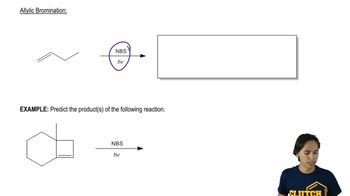
Step 1: Recognize that the reaction involves allylic bromination using NBS (N-Bromosuccinimide) under light (hv). NBS is commonly used to selectively brominate allylic or benzylic positions in the presence of a double bond.
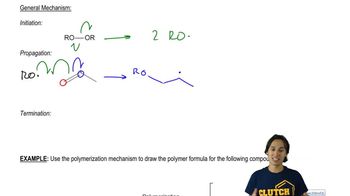
Step 2: Initiation phase: Light (hv) causes homolytic cleavage of the N-Br bond in NBS, generating a bromine radical (Br•). This radical is highly reactive and initiates the reaction.
Step 3: Propagation phase: The bromine radical abstracts a hydrogen atom from the allylic position of the cyclohexene molecule, forming an allylic radical. The allylic radical is stabilized by resonance, creating two possible resonance structures.
Step 4: Bromine from NBS reacts with the allylic radical to form the brominated products. The resonance structures of the allylic radical lead to two different products: (1) 3-bromocyclohexene and (2) 1-bromocyclohexene.
Step 5: Termination phase: Any remaining radicals combine to form stable molecules, completing the reaction. The observed products are the result of the selective bromination at the allylic positions due to the resonance stabilization of the intermediate radical.

Verified video answer for a similar problem:

This video solution was recommended by our tutors as helpful for the problem above.
Video duration:
5m
Was this helpful?

Key Concepts

Here are the essential concepts you must grasp in order to answer the question correctly.

Allylic Bromination

Allylic bromination is a reaction where bromine is added to the allylic position of an alkene or alkane. This process typically involves the formation of a radical intermediate, allowing for the substitution of a hydrogen atom with a bromine atom. The reaction is often facilitated by reagents like N-bromosuccinimide (NBS) in the presence of light, which generates bromine radicals that can abstract hydrogen atoms from the allylic position.
Recommended video:
Guided course
00:54
Mechanism of Allylic Bromination.

Radical Mechanism

The radical mechanism involves the formation and reaction of free radicals, which are highly reactive species with unpaired electrons. In the context of allylic bromination, the mechanism proceeds through three main steps: initiation (formation of bromine radicals), propagation (reaction of radicals with the substrate), and termination (recombination of radicals). Understanding this mechanism is crucial for predicting the products of the reaction and the regioselectivity of bromination.
Recommended video:
Guided course
03:28
The mechanism of Radical Polymerization.

Regioselectivity

Regioselectivity refers to the preference of a chemical reaction to yield one structural isomer over others when multiple possibilities exist. In allylic bromination, the regioselectivity is influenced by the stability of the radical intermediates formed during the reaction. More stable radicals, such as those formed at more substituted carbon centers, are favored, leading to specific products. This concept is essential for predicting the distribution of products in the reaction.
Recommended video:
Guided course
05:09
Heck Reaction
Related Practice
Textbook Question

Show the products you expect when each compound reacts with NBS with light shining on the reaction.

(c)

1253
views

Textbook Question

Show the products you expect when each compound reacts with NBS with light shining on the reaction.

(a)

(b)

706
views
Textbook Question

The following reaction takes place under second-order conditions (strong nucleophile), yet the structure of the product shows rearrangement. Also, the rate of this reaction is several thousand times faster than the rate of substitution of ­hydroxide ion on 2-chlorobutane under similar conditions. Propose a mechanism to explain the enhanced rate and ­rearrangement observed in this unusual reaction. (“Et” is the abbreviation for ethyl.)

659
views
Textbook Question

Propose mechanisms to account for the observed products in the following reactions.

(a)

936
views
Textbook Question

A student adds NBS to a solution of 1-methylcyclohexene and irradiates the mixture with a sunlamp until all the NBS has reacted. After a careful distillation, the product mixture contains two major products of formula C7H11Br.

(a) Draw the resonance forms of the three possible allylic free radical intermediates.

(b) Rank these three intermediates from most stable to least stable.

(c) Draw the products obtained from each free-radical intermediate.

948
views
Textbook Question

Furfuryl chloride can undergo substitution by both SN2 and SN1 mechanisms. Because it is a 1° alkyl halide, we expect SN2 but not SN1 reactions. Draw a mechanism for the SN1 reaction shown below, paying careful attention to the structure of the intermediate. How can this primary halide undergo SN1 reactions?

1793
views
1
rank