

Ch. 6 - Applications of Integration
Briggs - Calculus: Early Transcendentals 3rd Edition
Briggs3rd EditionCalculus: Early TranscendentalsISBN: 9780136847243Not the one you use?Change textbook
Chapter 6, Problem 6.1.10d

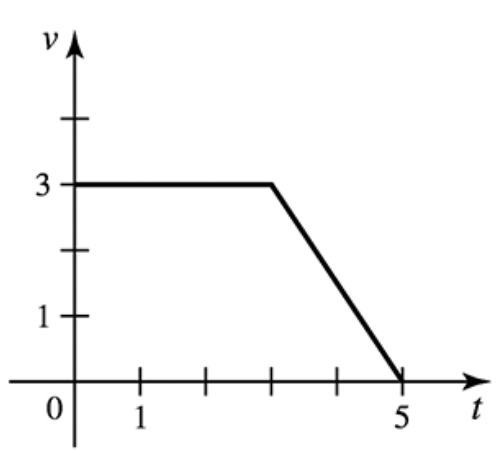
9–10. Velocity graphs The figures show velocity functions for motion along a line. Assume the motion begins with an initial position of s(0)=0. Determine the following.
img
d. A piecewise function for s(t)

Verified step by step guidance
1
Step 1: Understand that the velocity function \(v(t)\) is the derivative of the position function \(s(t)\), so \(s(t)\) can be found by integrating \(v(t)\) with respect to \(t\).
Step 2: Identify the piecewise definition of \(v(t)\) from the graph. For \(0 \leq t \leq 3\), \(v(t) = 3\). For \(3 < t \leq 5\), \(v(t)\) decreases linearly from 3 to 0, so find the equation of the line connecting points \((3,3)\) and \((5,0)\).
Step 3: Write the velocity function as a piecewise function: \(v(t) = \begin{cases} 3 & 0 \leq t \leq 3 \\ m t + b & 3 < t \leq 5 \end{cases}\) where \(m\) and \(b\) are the slope and intercept of the line segment from \(t=3\) to \(t=5\).
Step 4: Integrate each piece of \(v(t)\) to find \(s(t)\). For \(0 \leq t \leq 3\), integrate the constant velocity 3 to get \(s(t) = 3t + C_1\). Use the initial condition \(s(0) = 0\) to find \(C_1\).
Step 5: For \(3 < t \leq 5\), integrate the linear velocity function \(m t + b\) to get \(s(t) = \frac{m}{2} t^2 + b t + C_2\). Use continuity of \(s(t)\) at \(t=3\) to solve for \(C_2\).

Verified video answer for a similar problem:

This video solution was recommended by our tutors as helpful for the problem above.
Video duration:
5m
Was this helpful?

Key Concepts

Here are the essential concepts you must grasp in order to answer the question correctly.

Relationship Between Velocity and Position

Velocity is the derivative of position with respect to time, meaning that the position function s(t) can be found by integrating the velocity function v(t). Given an initial position s(0), integrating v(t) over time gives the displacement from the initial position.
Recommended video:
06:29
Derivatives Applied To Velocity

Piecewise Functions

A piecewise function is defined by different expressions over different intervals of the domain. In this problem, the velocity graph changes behavior at t=3 and t=5, so the position function s(t) must be expressed as a piecewise integral of v(t) over these intervals.
Recommended video:
05:36
Piecewise Functions

Definite Integration and Area Under the Curve

The position change over an interval is the definite integral of velocity over that interval, which corresponds to the area under the velocity curve. Calculating these areas for each piece of the velocity graph allows us to construct the position function s(t).
Recommended video:
05:43
Definition of the Definite Integral
Related Practice
Textbook Question

Bike race Theo and Sasha start at the same place on a straight road, riding bikes with the following velocities (measured in mi/hr). Assume t is measured in hours.

Theo: vT(t)=10, for t≥0

Sasha: vS(t)=15t, for 0≤t≤1, and vS(t)=15, for t>1


c. If the riders ride for 2 hr, who rides farther? Interpret your answer geometrically using the graphs of part (a). 

33
views
Textbook Question

Use the region R that is bounded by the graphs of y=1+√x,x=4, and y=1 complete the exercises.


Region R is revolved about the y-axis to form a solid of revolution whose cross sections are washers.


d. Write an integral for the volume of the solid.

54
views
Textbook Question

Displacement and distance from velocity Consider the velocity function shown below of an object moving along a line. Assume time is measured in seconds and distance is measured in meters. The areas of four regions bounded by the velocity curve and the t-axis are also given.

d. What is the displacement of the object over the interval [0, 8]? 

75
views
Textbook Question

9–10. Velocity graphs The figures show velocity functions for motion along a line. Assume the motion begins with an initial position of s(0)=0. Determine the following.

d. A piecewise function for s(t)

54
views
Textbook Question

Piecewise velocity The velocity of a (fast) automobile on a straight highway is given by the function

v(t)={3t if 0t<2060 if 20t<452404t if t45v(t)= \(\begin{cases}\)3 t & \(\text\) { if } 0 \(\leq\) t<20 \\ 60 & \(\text\) { if } 20 \(\leq\) t<45 \\ 240-4 t & \(\text\) { if } t \(\geq\) 45\(\end{cases}\)

where is measured in seconds and v has units of m/s. 

d. What is the position of the automobile when t=75?

48
views
Textbook Question

Acceleration A drag racer accelerates at a(t)=88 ft/s². Assume v(0)=0, s(0)=0, and t is measured in seconds.


d. How long does it take the racer to travel 300 ft?

27
views