

Ch. 6 - Applications of Integration
Briggs - Calculus: Early Transcendentals 3rd Edition
Briggs3rd EditionCalculus: Early TranscendentalsISBN: 9780136847243Not the one you use?Change textbook
Chapter 6, Problem 6.3.8d

Use the region R that is bounded by the graphs of y=1+√x,x=4, and y=1 complete the exercises.


Region R is revolved about the y-axis to form a solid of revolution whose cross sections are washers.


d. Write an integral for the volume of the solid.

Verified step by step guidance
1
Step 1: Understand the problem. The region R is bounded by the graphs of y = 1 + √x, x = 4, and y = 1. The goal is to find the volume of the solid formed when this region is revolved about the y-axis using the washer method.
Step 2: Express x in terms of y for the curve y = 1 + √x. Rearrange the equation to isolate √x: √x = y - 1. Then square both sides to get x = (y - 1)^2.
Step 3: Determine the bounds for y. The region starts at y = 1 (the horizontal line) and ends at y = 1 + √4 = 3 (since x = 4). Thus, the bounds for y are from 1 to 3.
Step 4: Set up the washer method formula for the volume. The volume of the solid is given by the integral: V = π ∫[y₁ to y₂] [(Outer radius)^2 - (Inner radius)^2] dy. Here, the outer radius is x = (y - 1)^2, and the inner radius is x = 4.
Step 5: Write the integral. Substitute the bounds and radii into the formula: V = π ∫[1 to 3] [(y - 1)^4 - 4^2] dy. This integral represents the volume of the solid formed by revolving the region R about the y-axis.

Verified video answer for a similar problem:

This video solution was recommended by our tutors as helpful for the problem above.
Video duration:
3m
Was this helpful?

Key Concepts

Here are the essential concepts you must grasp in order to answer the question correctly.

Solid of Revolution

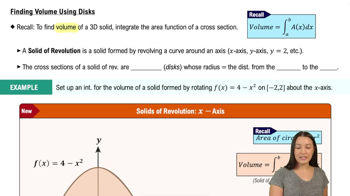
A solid of revolution is a three-dimensional shape created by rotating a two-dimensional area around an axis. In this case, the region R is revolved around the y-axis, which means the volume of the solid can be calculated using methods such as the disk or washer method, depending on the shape of the cross-sections.
Recommended video:
04:48
Finding Volume Using Disks

Washer Method

The washer method is a technique used to find the volume of a solid of revolution when the cross-sections are washers (disks with holes). It involves integrating the area of the outer radius minus the area of the inner radius, typically expressed as π(R^2 - r^2), where R and r are the outer and inner radii, respectively.
Recommended video:
07:33
Euler's Method

Definite Integral

A definite integral is a mathematical expression that calculates the accumulation of quantities, such as area or volume, over a specific interval. In this context, the definite integral will be set up to evaluate the volume of the solid formed by revolving region R around the y-axis, integrating from the lower to the upper bounds of the region.
Recommended video:
05:43
Definition of the Definite Integral
Related Practice
Textbook Question

Bike race Theo and Sasha start at the same place on a straight road, riding bikes with the following velocities (measured in mi/hr). Assume t is measured in hours.

Theo: vT(t)=10, for t≥0

Sasha: vS(t)=15t, for 0≤t≤1, and vS(t)=15, for t>1


c. If the riders ride for 2 hr, who rides farther? Interpret your answer geometrically using the graphs of part (a). 

33
views
Textbook Question

9–10. Velocity graphs The figures show velocity functions for motion along a line. Assume the motion begins with an initial position of s(0)=0. Determine the following.

d. A piecewise function for s(t)

89
views
Textbook Question

Displacement and distance from velocity Consider the velocity function shown below of an object moving along a line. Assume time is measured in seconds and distance is measured in meters. The areas of four regions bounded by the velocity curve and the t-axis are also given.

d. What is the displacement of the object over the interval [0, 8]? 

75
views
Textbook Question

9–10. Velocity graphs The figures show velocity functions for motion along a line. Assume the motion begins with an initial position of s(0)=0. Determine the following.

d. A piecewise function for s(t)

54
views
Textbook Question

Acceleration A drag racer accelerates at a(t)=88 ft/s². Assume v(0)=0, s(0)=0, and t is measured in seconds.


d. How long does it take the racer to travel 300 ft?

27
views
Textbook Question

Flying into a headwind The velocity (in mi/hr) of an airplane flying into a headwind is given by v(t) = 30(16−t²), for 0≤t≤3. Assume s(0)=0 and t is measured in hours.


c. How far has the airplane traveled at the instant its velocity reaches 400 mi/hr?

53
views