
Ch. 6 - Applications of Integration
Briggs - Calculus: Early Transcendentals 3rd Edition
Briggs3rd EditionCalculus: Early TranscendentalsISBN: 9780136847243Not the one you use?Change textbook
Chapter 6, Problem 6.1.65c

Bike race Theo and Sasha start at the same place on a straight road, riding bikes with the following velocities (measured in mi/hr). Assume t is measured in hours.
Theo: vT(t)=10, for t≥0
Sasha: vS(t)=15t, for 0≤t≤1, and vS(t)=15, for t>1


c. If the riders ride for 2 hr, who rides farther? Interpret your answer geometrically using the graphs of part (a). 

Verified step by step guidance
1
Understand that the distance each rider travels is the integral of their velocity function over the time interval from 0 to 2 hours. This is because distance is the area under the velocity-time graph.
For Theo, whose velocity is constant at \(v_T(t) = 10\) mi/hr, calculate the distance by integrating the constant velocity over 2 hours: \(\int_0^2 10 \, dt\).
For Sasha, whose velocity changes, split the integral into two parts: from 0 to 1 hour where \(v_S(t) = 15t\), and from 1 to 2 hours where \(v_S(t) = 15\). So, calculate \(\int_0^1 15t \, dt + \int_1^2 15 \, dt\).
Evaluate both integrals (without computing the final numerical values here) to find the total distance each rider covers in 2 hours.
Compare the two distances to determine who rides farther. Geometrically, this corresponds to comparing the areas under each velocity curve on the graph from 0 to 2 hours.

Verified video answer for a similar problem:

This video solution was recommended by our tutors as helpful for the problem above.
Video duration:
4m
Was this helpful?

Key Concepts

Here are the essential concepts you must grasp in order to answer the question correctly.

Velocity as a Function of Time

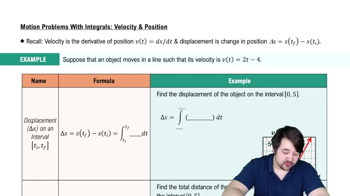
Velocity describes how fast an object moves and in which direction, often expressed as a function of time. Understanding velocity functions allows us to analyze how speed changes over time, such as Theo's constant velocity and Sasha's piecewise velocity that increases then remains constant.
Recommended video:
10:17
Using The Velocity Function

Distance Traveled as the Integral of Velocity

The total distance traveled over a time interval is found by integrating the velocity function over that interval. This means calculating the area under the velocity-time graph, which represents the accumulation of movement over time.
Recommended video:
10:17
Using The Velocity Function

Interpreting Graphs of Piecewise Functions

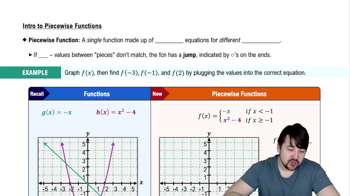
Piecewise functions have different expressions over different intervals. Interpreting their graphs involves understanding how the function changes shape, such as Sasha's velocity increasing linearly then becoming constant, which affects the area under the curve and thus the total distance.
Recommended video:
05:36
Piecewise Functions
Related Practice