Back
Back
Problem 6.4.68
64–68. Shell method Use the shell method to find the volume of the following solids.
A hole of radius r≤R is drilled symmetrically along the axis of a bullet. The bullet is formed by revolving the parabola y = 6(1−x²/R²) about the y-axis, where 0≤x≤R.
Problem 6.4.19
9-34. Shell method Let R be the region bounded by the following curves. Use the shell method to find the volume of the solid generated when R is revolved about indicated axis.
y = 1−x²,x = 0, and y = 0, in the first quadrant; about the y-axis
Problem 6.2.15
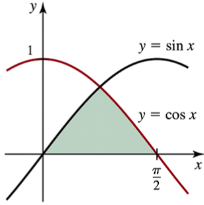
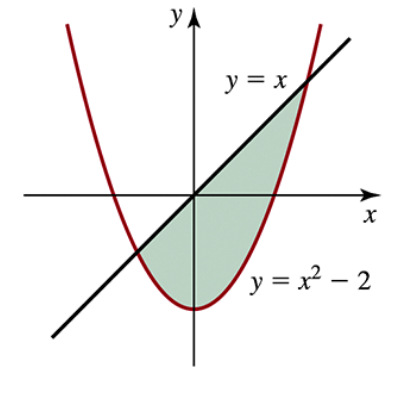
Determine the area of the shaded region in the following figures.
Problem 6.3.28
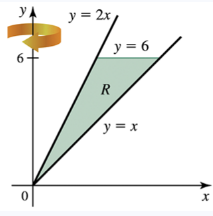
Let R be the region bounded by the following curves. Find the volume of the solid generated when R is revolved about the given axis.
y=x,y=2x, and y=6 ; about the y-axis
Problem 6.2.45
Find the area of the region described in the following exercises.
The region bounded by y=2−|x|and y=x^2
Problem 6.2.49
Find the area of the region described in the following exercises.
The region in the first quadrant bounded by y=x^2/3 and y=4
Problem 6.7.21
Work from force How much work is required to move an object from x=0 to x=3 (measured in meters) in the presence of a force (in N) given by F(x)=2x acting along the x-axis?
Problem 6.1.72
Without evaluating integrals, prove that ∫₀² d/dx(12 sin πx²) dx=∫₀² d/dx (x¹⁰(2−x)³) dx.
Problem 6.3.64
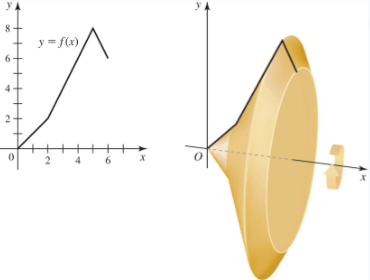
Let f(x) = {x if 0≤x≤2
2x−2 if 2<x≤5
−2x+18 if 5<x≤6.
Find the volume of the solid formed when the region bounded by the graph of f, the x-axis, and the line x=6 is revolved about the x-axis.
Problem 6.4.1
Assume f and g are continuous, with f(x) ≥ g(x) ≥ 0 on [a, b]. The region bounded by the graphs of f and g and the lines x=a and x=b is revolved about the y-axis. Write the integral given by the shell method that equals the volume of the resulting solid.
Problem 6.3.51
Let R be the region bounded by the following curves. Find the volume of the solid generated when R is revolved about the given line.
x=2−secy,x=2,y=π/3, and y=0; about x=2
Problem 6.7.34
Leaky Bucket A 1-kg bucket resting on the ground contains 3 kg of water. How much work is required to raise the bucket vertically a distance of 10 m if water leaks out of the bucket at a constant rate of 1/5 kg/m? Assume the weight of the rope used to raise the bucket is negligible. (Hint: Use the definition of work, W = ∫a^bF(y) dy, where F is the variable force required to lift an object along a vertical line from y=a to y=b.)
Problem 6.1.69
Suppose f and g have continuous derivatives on an interval [a, b]. Prove that if f(a)=g(a) and f(b)=g(b), then ∫a^b f′(x) dx = ∫a^b g′(x) dx.
Problem 6.2.39
Find the area of the region described in the following exercises.
The region bounded by y=e^x, y=e^−2x, and x=ln 4
Problem 6.7.63
Drinking juice A glass has circular cross sections that taper (linearly) from a radius of 5 cm at the top of the glass to a radius of 4 cm at the bottom. The glass is 15 cm high and full of orange juice. How much work is required to drink all the juice through a straw if your mouth is 5 cm above the top of the glass? Assume the density of orange juice equals the density of water.
Problem 6.5.9
9–20. Arc length calculations Find the arc length of the following curves on the given interval.
y = −8x−3 on [−2, 6] (Use calculus.)
Problem 6.4.22
9-34. Shell method Let R be the region bounded by the following curves. Use the shell method to find the volume of the solid generated when R is revolved about indicated axis.
x = x³ ,y = 1, and x = 0; about the x-axis
Problem 6.1.30
29–36. Position and velocity from acceleration Find the position and velocity of an object moving along a straight line with the given acceleration, initial velocity, and initial position. Use the Fundamental Theorem of Calculus (Theorems 6.1 and 6.2).
a(t) = −32; v(0)=50; s(0)=0
Problem 6.7.2
Explain how to find the mass of a one-dimensional object with a variable density ρ.
Problem 6.2.7
Express the area of the shaded region in Exercise 5 as the sum of two integrals with respect to y. Do not evaluate the integrals.
Problem 6.6.13
Find the area of the surface generated when the given curve is revolved about the given axis.
y=√1−x^2, for −1/2≤x≤1/2; about the x-axis
Problem 6.3.55
Let R be the region bounded by the following curves. Find the volume of the solid generated when R is revolved about the given line.
y=2 sin x and y=0 on [0,π]; about y=−2
Problem 6.2.9
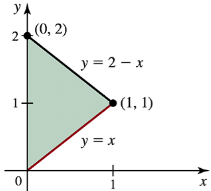
Determine the area of the shaded region in the following figures.
Problem 6.3.1
Suppose a cut is made through a solid object perpendicular to the x-axis at a particular point x. Explain the meaning of A(x).
Problem 6.4.38
35–38. Shell and washer methods Let R be the region bounded by the following curves. Use both the shell method and the washer method to find the volume of the solid generated when R is revolved about the indicated axis.
y = 8,y = 2x+2,x = 0, and x=2; about the y-axis
Problem 6.3.12
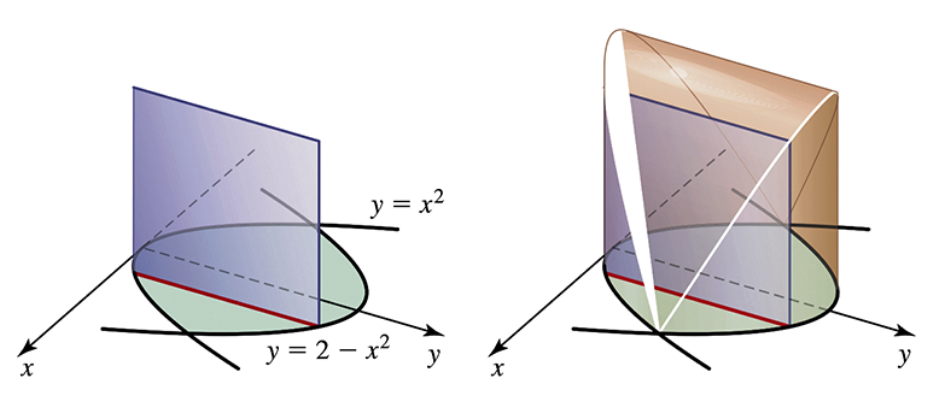
Use the general slicing method to find the volume of the following solids.
The solid whose base is the region bounded by the curves y=x^2 and y=2−x^2, and whose cross sections through the solid perpendicular to the x-axis are squares
Problem 6.5.19
9–20. Arc length calculations Find the arc length of the following curves on the given interval.
x = 2y−4, for −3≤y≤4 (Use calculus, but check your work using geometry.)
Problem 6.7.18
13–20. Mass of one-dimensional objects Find the mass of the following thin bars with the given density function.
ρ(x) = {1 if 0≤x≤2 {2 if 2<x≤3
Problem 6.4.41
39–44. Shell method about other lines Let R be the region bounded by y = x²,x=1, and y=0. Use the shell method to find the volume of the solid generated when R is revolved about the following lines.
x =2
Problem 6.4.30
9-34. Shell method Let R be the region bounded by the following curves. Use the shell method to find the volume of the solid generated when R is revolved about indicated axis.
{Use of Tech} y = In x/x²,y = 0,x = 3, about the y-axis