Back
Back
Problem 7.RE.1a
Explain why or why not Determine whether the following statements are true and give an explanation or counterexample.
a. The variable y = t + 1 doubles in value whenever t increases by 1 unit.
Problem 7.RE.23a
Moore’s Law In 1965, Gordon Moore observed that the number of transistors that could be placed on an integrated circuit was approximately doubling each year, and he predicted that this trend would continue for another decade. In 1975, Moore revised the doubling time to every two years, and this prediction became known as Moore’s Law.
a. In 1979, Intel introduced the Intel 8088 processor; each of its integrated circuits contained 29,000 transistors. Use Moore’s revised doubling time to find a function y(t) that approximates the number of transistors on an integrated circuit t years after 1979.
Problem 7.RE.20b
Population growth The population of a large city grows exponentially with a current population of 1.3 million and a predicted population of 1.45 million 10 years from now.
b. Find the doubling time of the population.
Problem 7.RE.2
2–9. Integrals Evaluate the following integrals.
∫ (eˣ / (4eˣ + 6)) dx
Problem 7.RE.5
2–9. Integrals Evaluate the following integrals.
∫ (x + 4) / (x² + 8x + 25) dx
Problem 7.RE.26b
Savings account A savings account advertises an annual percentage yield (APY) of 5.4%, which means that the balance in the account increases at an annual growth rate of 5.4%/yr.
b. What is the doubling time of the balance?
Problem 7.RE.24
Radioactive decay The mass of radioactive material in a sample has decreased by 30% since the decay began. Assuming a half-life of 1500 years, how long ago did the decay begin?
Problem 7.3.61a
61–62. Points of intersection and area
a. Sketch the graphs of the functions f and g and find the x-coordinate of the points at which they intersect.
f(x) = sech x, g(x) = tanh x; the region bounded by the graphs of f, g, and the y-axis
Problem 7.2.23a
Projection sensitivity
According to the 2014 national population projections published by the U.S. Census Bureau, the U.S. population is projected to be 334.4 million in 2020 with an estimated growth rate of 0.79%/yr.
a. Based on these figures, find the doubling time and the projected population in 2050. Assume the growth rate remains constant.
Problem 7.3.74a
Wave velocity Use Exercise 73 to do the following calculations.
a. Find the velocity of a wave where λ = 50 m and d = 20 m.
Problem 7.3.95a
Falling body When an object falling from rest encounters air resistance proportional to the square of its velocity, the distance it falls (in meters) after t seconds is given by d(t) = (m/k) ln (cosh (√(kg/m) t)), where m is the mass of the object in kilograms, g = 9.8 m/s² is the acceleration due to gravity, and k is a physical constant.
a. A BASE jumper (m = 75 kg) leaps from a tall cliff and performs a ten-second delay (she free-falls for 10 s and then opens her chute). How far does she fall in 10 s? Assume k = 0.2.
Problem 7.3.79a
Evaluating hyperbolic functions Evaluate each expression without using a calculator or state that the value does not exist. Simplify answers as much as possible.
a. cosh 0
Problem 7.1.71a
Zero net area Consider the function f(x) = (1 − x)/x
a. Are there numbers 0 < a < 1 such that ∫₁₋ₐ¹⁺ᵃ f(x) dx = 0?
Problem 7.2.32a
Depreciation of equipment A large die-casting machine used to make automobile engine blocks is purchased for $2.5 million. For tax purposes, the value of the machine can be depreciated by 6.8% of its current value each year.
a. What is the value of the machine after 10 years?
Problem 7.3.96a
Velocity of falling body Refer to Exercise 95, which gives the position function for a falling body. Use m = 75 kg and k = 0.2.
a. Confirm that the BASE jumper’s velocity t seconds after jumping is v(t) = d'(t) = √(mg/k) tanh (√(kg/m) t).
Problem 7.1.74a
ln x is unbounded Use the following argument to show that lim (x → ∞) ln x = ∞ and lim (x → 0⁺) ln x = −∞.
a. Make a sketch of the function f(x) = 1/x on the interval [1, 2]. Explain why the area of the region bounded by y = f(x) and the x-axis on [1, 2] is ln 2.
Problem 7.3.78a
Evaluating hyperbolic functions Use a calculator to evaluate each expression or state that the value does not exist. Report answers accurate to four decimal places to the right of the decimal point.
a. coth 4
Problem 7.2.45a
Chemotherapy In an experimental study at Dartmouth College, mice with tumors were treated with the chemotherapeutic drug Cisplatin. Before treatment, the tumors consisted entirely of clonogenic cells that divide rapidly, causing the tumors to double in size every 2.9 days. Immediately after treatment, 99% of the cells in the tumor became quiescent cells which do not divide and lose 50% of their volume every 5.7 days. For a particular mouse, assume the tumor size is 0.5 cm³ at the time of treatment.
a. Find an exponential decay function V₁(t) that equals the total volume of the quiescent cells in the tumor t days after treatment.
Problem 7.2.24a
Energy consumption On the first day of the year (t=0), a city uses electricity at a rate of 2000 MW. That rate is projected to increase at a rate of 1.3% per year.
a. Based on these figures, find an exponential growth function for the power (rate of electricity use) for the city.
Problem 7.3.59a
Visual approximation
a. Use a graphing utility to sketch the graph of y = coth x and then explain why ∫₅¹⁰ coth x dx ≈ 5.
Problem 7.3.75a
Shallow-water velocity equation
a. Confirm that the linear approximation to ƒ(x) = tanh x at a = 0 is L(x) = x.
Problem 7.3.97a
Terminal velocity Refer to Exercises 95 and 96.
a. Compute a jumper’s terminal velocity, which is defined as lim t → ∞ v(t) = lim t → ∞ √(mg/k) tanh (√(kg/m) t).
Problem 7.3.71a
A power line is attached at the same height to two utility poles that are separated by a distance of 100 ft; the power line follows the curve ƒ(x) = a cosh x/a. Use the following steps to find the value of a that produces a sag of 10 ft midway between the poles. Use a coordinate system that places the poles at x = ±50.
a. Show that a satisfies the equation cosh 50/a − 1 = 10/a.
Problem 7.3.38b
37–38. Caffeine After an individual drinks a beverage containing caffeine, the amount of caffeine in the bloodstream can be modeled by an exponential decay function, with a half-life that depends on several factors, including age and body weight. For the sake of simplicity, assume the caffeine in the following drinks immediately enters the bloodstream upon consumption.
An individual consumes two cups of coffee, each containing 90 mg of caffeine, two hours apart. Assume the half-life of caffeine for this individual is 5.7 hours.
b. Determine the amount of caffeine in the bloodstream 1 hour after drinking the second cup of coffee.
Problem 7.1.73b
Properties of exp(x) Use the inverse relations between ln x and exp(x), and the properties of ln x, to prove the following properties:
b. exp(x − y) = exp(x) / exp(y)
Problem 7.2.32b
Depreciation of equipment A large die-casting machine used to make automobile engine blocks is purchased for $2.5 million. For tax purposes, the value of the machine can be depreciated by 6.8% of its current value each year.
b. After how many years is the value of the machine 10% of its original value?
Problem 7.3.112b
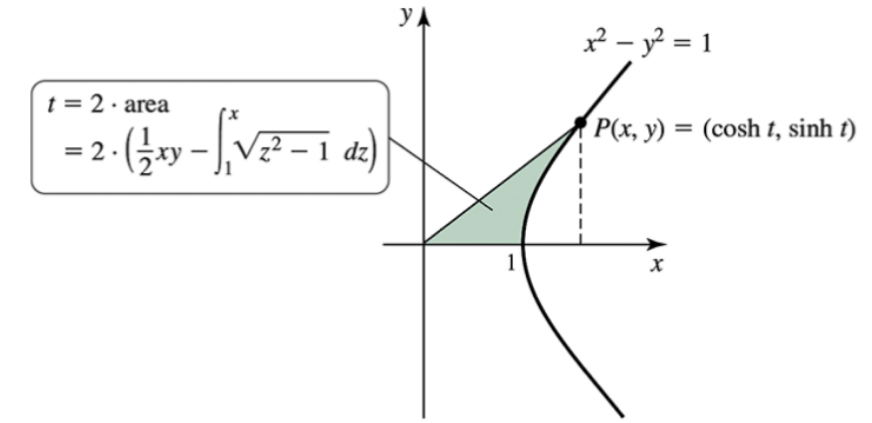
Definitions of hyperbolic sine and cosine Complete the following steps to prove that when the x- and y-coordinates of a point on the hyperbola x² - y² = 1 are defined as cosh t and sinh t, respectively, where t is twice the area of the shaded region in the figure, x and y can be expressed as
x = cosh t = (eᵗ + e⁻ᵗ) / 2 and y = sinh t = (eᵗ - e⁻ᵗ) / 2.
b. In Chapter 8, the formula for the integral in part (a) is derived:
∫ √(z² − 1) dz = (z/2)√(z² − 1) − (1/2) ln|z + √(z² − 1)| + C.
Evaluate this integral on the interval [1, x], explain why the absolute value can be dropped, and combine the result with part (a) to show that:
t = ln(x + √(x² − 1)).
Problem 7.3.108b
"Integral formula Carry out the following steps to derive the formula ∫ csch x dx = ln |tanh(x / 2)| + C (Theorem 7.6).
b. Use the identity for sinh(2u) to show that 2 / sinh(2u) = sech² u / tanh u."
Problem 7.3.107b
Many formulas There are several ways to express the indefinite integral of sech x.
b. Show that ∫ sech x dx = sin⁻¹ (tanh x) + C. (Hint: Show that sech x = sech² x / √(1 − tanh² x) and then make a change of variables.)
Problem 7.2.26b
Oil consumption Starting in 2018 (t=0), the rate at which oil is consumed by a small country increases at a rate of 1.5%/yr, starting with an initial rate of 1.2 million barrels/yr.
b. Find the function that gives the amount of oil consumed between t=0 and any future time t.