Back
Back
Problem 3.9.48a
Tolerance
a. About how accurately must the interior diameter of a 10-m-high cylindrical storage tank be measured to calculate the tank’s volume to within 1% of its true value?
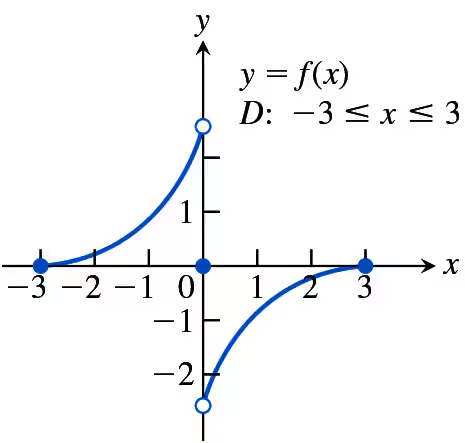
Problem 3.2.47a
Differentiability and Continuity on an Interval
Each figure in Exercises 45–50 shows the graph of a function over a closed interval D. At what domain points does the function appear to be
a. differentiable?
Give reasons for your answers.
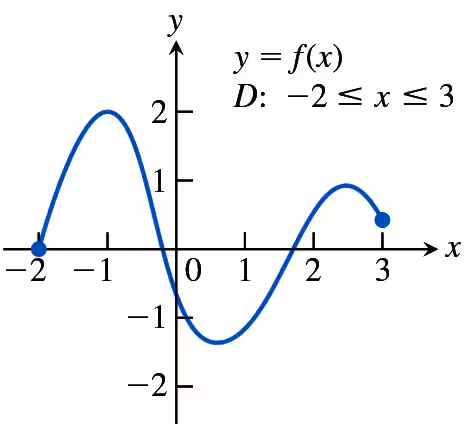
Problem 3.2.46a
Differentiability and Continuity on an Interval
Each figure in Exercises 45–50 shows the graph of a function over a closed interval D. At what domain points does the function appear to be
a. differentiable?
Give reasons for your answers.
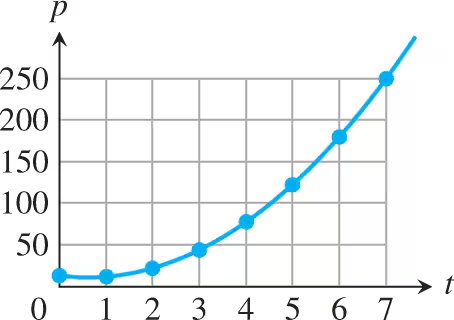
Problem 3.1.23a
Interpreting Derivative Values
Growth of yeast cells In a controlled laboratory experiment, yeast cells are grown in an automated cell culture system that counts the number P of cells present at hourly intervals. The number after t hours is shown in the accompanying figure.
a. Explain what is meant by the derivative P'(5). What are its units?
Problem 3.4.4a
Motion Along a Coordinate Line
Exercises 1–6 give the positions s = f(t) of a body moving on a coordinate line, with s in meters and t in seconds.
a. Find the body’s displacement and average velocity for the given time interval.
s = (t⁴/4) − t³ + t², 0 ≤ t ≤ 3
Problem 3.7.60a
Computer Explorations
Use a CAS to perform the following steps in Exercises 55–62.
a. Plot the equation with the implicit plotter of a CAS. Check to see that the given point P satisfies the equation.
xy³ + tan(x + y) = 1, P(π/4, 0)
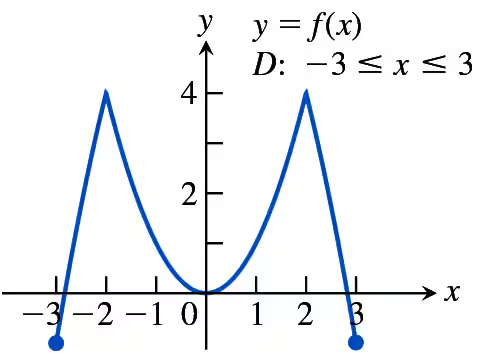
Problem 3.2.50a
Differentiability and Continuity on an Interval
Each figure in Exercises 45–50 shows the graph of a function over a closed interval D. At what domain points does the function appear to be
a. differentiable?
Give reasons for your answers.
Problem 3.5.34a
Find y⁽⁴⁾ = d⁴y/dx⁴ if:
a. y = −2 sin x
Problem 3.7.61a
Computer Explorations
Use a CAS to perform the following steps in Exercises 55–62.
a. Plot the equation with the implicit plotter of a CAS. Check to see that the given point P satisfies the equation.
2y² + (xy)¹/³ = x² + 2, P(1,1)
Problem 3.5.53b
By computing the first few derivatives and looking for a pattern, find the following derivatives.
b. d¹¹⁰/dx¹¹⁰ (sin x − 3 cos x)
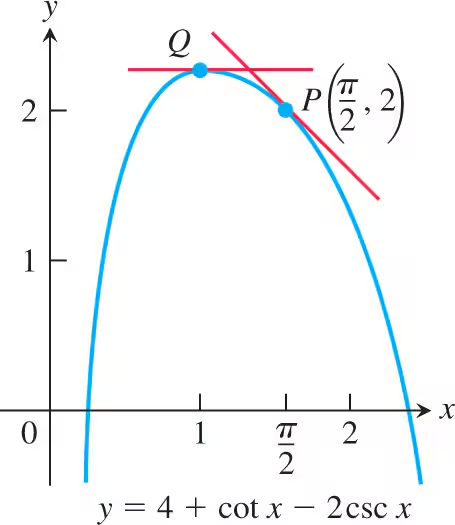
Problem 3.5.47b
In Exercises 47 and 48, find an equation for
(b) the horizontal tangent line to the curve at Q.
Problem 3.4.8b
Particle motion At time t ≥ 0, the velocity of a body moving along the horizontal s-axis is v = t² − 4t + 3.
b. When is the body moving forward? Backward?
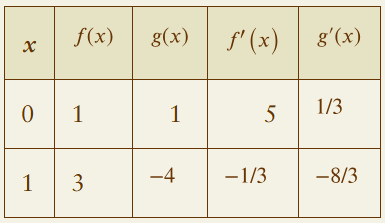
Problem 3.6.76b
Suppose that the functions f and g and their derivatives with respect to x have the following values at x = 0 and x = 1.
Find the derivatives with respect to x of the following combinations at the given value of x.
b. f(x)g³(x), x = 0
Problem 3.2.54b
Theory and Examples
In Exercises 51–54,
b. Graph y = f(x) and y = f'(x) side by side using separate sets of coordinate axes, and answer the following questions.
y = x⁴/4
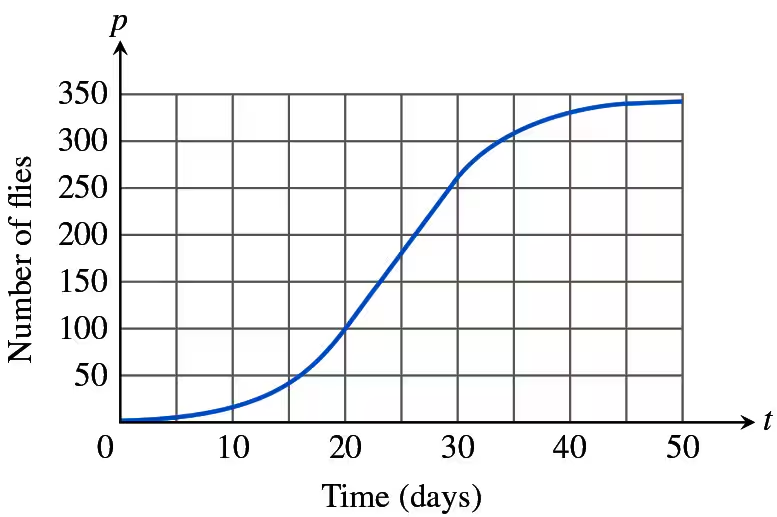
Problem 3.2.34b
Fruit flies (Continuation of Example 4, Section 2.1.) Populations starting out in closed environments grow slowly at first, when there are relatively few members, then more rapidly as the number of reproducing individuals increases and resources are still abundant, then slowly again as the population reaches the carrying capacity of the environment.
b. During what days does the population seem to be increasing fastest? Slowest?
Problem 3.6.83b
b. Slopes on a tangent curve What is the smallest value the slope of the curve can ever have on the interval −2 < x < 2? Give reasons for your answer.
Problem 3.7.61b
Computer Explorations
Use a CAS to perform the following steps in Exercises 55–62.
b. Using implicit differentiation, find a formula for the derivative dy/dx and evaluate it at the given point P.
2y² + (xy)¹/³ = x² + 2, P(1,1)
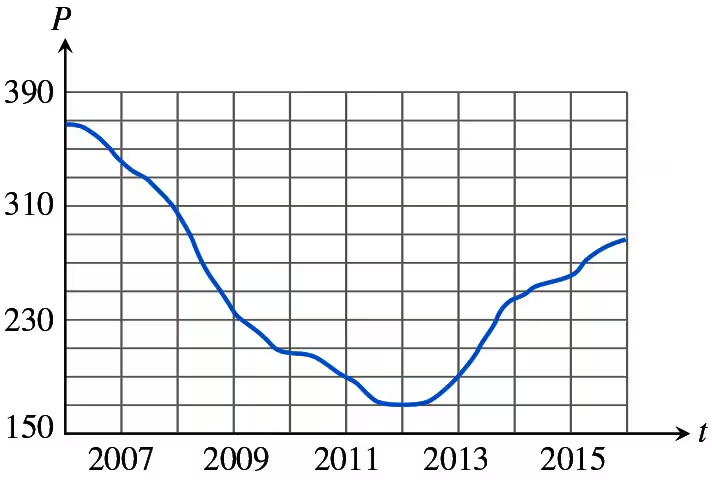
Problem 3.2.36b
Average single-family home prices P (in thousands of dollars) in Sacramento, California, are shown in the accompanying figure from the beginning of 2006 through the end of 2015.
b. Estimate home prices at the end of
i) 2007 ii) 2012 iii) 2015
Problem 3.9.45b
The radius r of a circle is measured with an error of at most 2%. What is the maximum corresponding percentage error in computing the circle’s
b. area?
Problem 3.8.32b
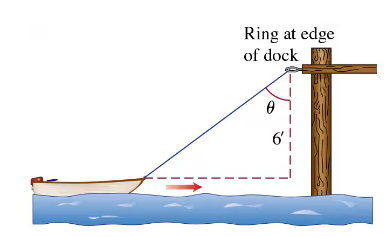
Hauling in a dinghy A dinghy is pulled toward a dock by a rope from the bow through a ring on the dock 6 ft above the bow. The rope is hauled in at the rate of 2 ft/sec.
b. At what rate is the angle θ changing at this instant (see the figure)?
Problem 3.8.19b
Area The area A of a triangle with sides of lengths a and b enclosing an angle of measure θ is
A = (1/2) ab sinθ.
b. How is dA/dt related to dθ/dt and da/dt if only b is constant?
Problem 3.6.98b
Consider the function
f(x) = { x² cos(2/x), x ≠ 0
0, x = 0
b. Determine f' for x ≠ 0.
Problem 3.96b
Right circular cone The lateral surface area S of a right circular cone is related to the base radius r and height h by the equation
______
S = πr √ r² + h².
b. How is dS/dt related to dh/dt if r is constant?
Problem 3.6.86b
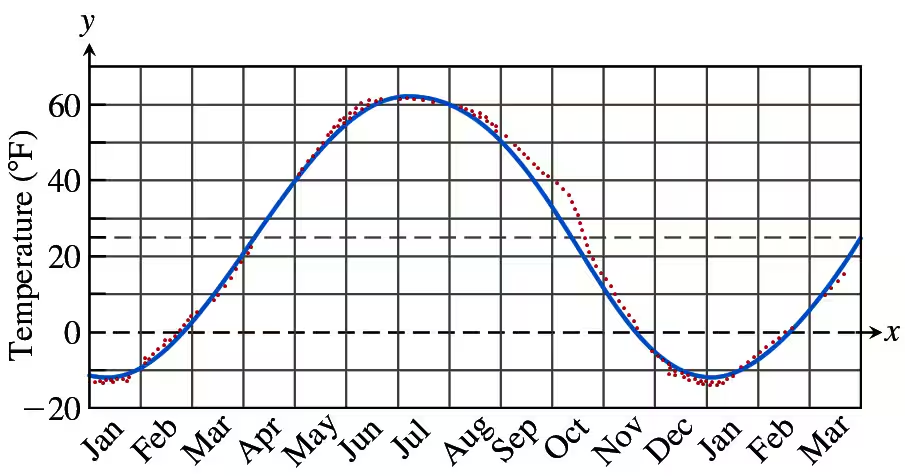
Temperatures in Fairbanks, Alaska The graph in the accompanying figure shows the average Fahrenheit temperature in Fairbanks, Alaska, during a typical 365-day year. The equation that approximates the temperature on day x is
y = 37 sin[(2π/365)(x − 101)] + 25
and is graphed in the accompanying figure.
b. About how many degrees per day is the temperature increasing when it is increasing at its fastest?
Problem 3.4.5b
Motion Along a Coordinate Line
Exercises 1–6 give the positions s = f(t) of a body moving on a coordinate line, with s in meters and t in seconds.
b. Find the body’s speed and acceleration at the endpoints of the interval.
s = 25/t² − 5/t, 1 ≤ t ≤ 5
Problem 3.4.31b
Analyzing Motion Using Graphs
[Technology Exercise] Exercises 31–34 give the position function s = f(t) of an object moving along the s-axis as a function of time t. Graph f together with the velocity function v(t) = ds/dt = f'(t) and the acceleration function a(t) = d²s/dt² = f''(t). Comment on the object’s behavior in relation to the signs and values of v and a. Include in your commentary such topics as the following:
b. When does it move to the left (down) or to the right (up)?
s = 200t - 16t², 0 ≤ t ≤ 12.5 (a heavy object fired straight up from Earth’s surface at 200 ft/sec)
Problem 3.9.55b
Quadratic approximations
b. Find the quadratic approximation to f(x) = 1/(1 − x) at x = 0.
Problem 3.95b
Right circular cylinder The total surface area S of a right circular cylinder is related to the base radius r and height h by the equation S = 2πr² + 2πrh.
b. How is dS/dt related to dh/dt if r is constant?
Problem 3.8.23b
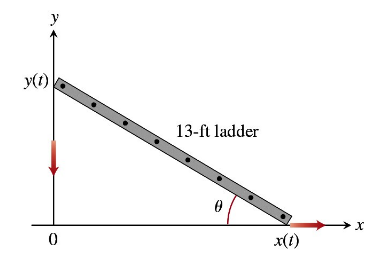
A sliding ladder
A 13-ft ladder is leaning against a house when its base starts to slide away. By the time the base is 12 ft from the house, the base is moving at the rate of 5 ft/sec.
b. At what rate is the area of the triangle formed by the ladder, wall, and ground changing then?
Problem 3.7.62b
Computer Explorations
Use a CAS to perform the following steps in Exercises 55–62.
b. Using implicit differentiation, find a formula for the derivative dy/dx and evaluate it at the given point P.
x√(1 + 2y) + y = x², P(1,0)