Back
Back
Problem 4.3.5b
Analyzing Functions from Derivatives
Answer the following questions about the functions whose derivatives are given in Exercises 1–14:
b. On what open intervals is f increasing or decreasing?
f′(x) = (x − 1)(x + 2)(x − 3)
Problem 4.7.6b
Finding Antiderivatives
In Exercises 1–16, find an antiderivative for each function. Do as many as you can mentally. Check your answers by differentiation.
1 / 2x³
Problem 4.1.51b
Theory and Examples
In Exercises 51 and 52, give reasons for your answers.
Let f(x) = (x − 2)²ᐟ³.
b. Show that the only local extreme value of f occurs at x = 2.
Problem 4.7.16b
Finding Antiderivatives
In Exercises 1–16, find an antiderivative for each function. Do as many as you can mentally. Check your answers by differentiation.
4 sec 3x tan 3x
Problem 4.7.10b
Finding Antiderivatives
In Exercises 1–16, find an antiderivative for each function. Do as many as you can mentally. Check your answers by differentiation.
-(1/2)x⁻³ᐟ²
Problem 4.5.38b
38. What values of a and b make f(x) = x^3 + ax^2 + bx have
b. a local minimum at x = 4 and a point of inflection at x = 1?
Problem 4.3.63b
Identifying Extrema
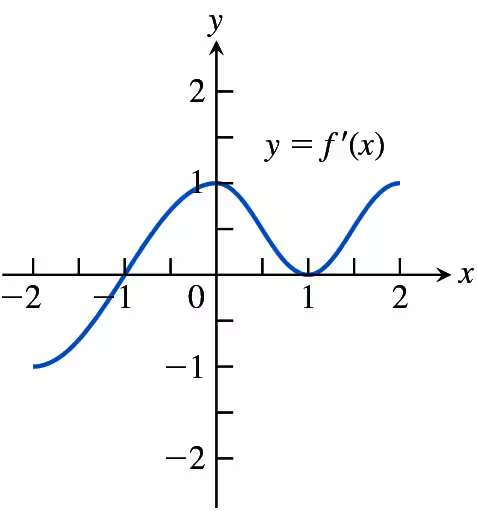
In Exercises 63 and 64, the graph of f' is given. Assume that f has domain (-2, 2).
b. Either use the graph to determine which intervals f is positive on and which intervals f is negative on, or explain why this information cannot be determined from the graph.
Problem 4.3.3b
Analyzing Functions from Derivatives
Answer the following questions about the functions whose derivatives are given in Exercises 1–14:
b. On what open intervals is f increasing or decreasing?
f′(x) = (x − 1)²(x + 2)
Problem 4.7.4b
Finding Antiderivatives
In Exercises 1–16, find an antiderivative for each function. Do as many as you can mentally. Check your answers by differentiation.
x⁻³/2 + x²
Problem 4.3.9b
Analyzing Functions from Derivatives
Answer the following questions about the functions whose derivatives are given in Exercises 1–14:
b. On what open intervals is f increasing or decreasing?
f′(x) = 1− 4/x², x ≠ 0
Problem 4.7.11c
Finding Antiderivatives
In Exercises 1–16, find an antiderivative for each function. Do as many as you can mentally. Check your answers by differentiation.
sin πx − 3sin 3x
Problem 4.7.9c
Finding Antiderivatives
In Exercises 1–16, find an antiderivative for each function. Do as many as you can mentally. Check your answers by differentiation.
-(1/3)x⁻⁴ᐟ³
Problem 4.7.7c
Finding Antiderivatives
In Exercises 1–16, find an antiderivative for each function. Do as many as you can mentally. Check your answers by differentiation.
√x + 1/√x
Problem 4.7.64c
Checking Antiderivative Formulas
Right, or wrong? Say which for each formula and give a brief reason for each answer.
∫tanθ sec²θ dθ = (1/2) sec²θ + C
Problem 4.3.1c
Analyzing Functions from Derivatives
Answer the following questions about the functions whose derivatives are given in Exercises 1–14:
c. At what points, if any, does f assume local maximum or minimum values?
f′(x) = x(x − 1)
Problem 4.7.13c
Finding Antiderivatives
In Exercises 1–16, find an antiderivative for each function. Do as many as you can mentally. Check your answers by differentiation.
-sec²(3x/2)
Problem 4.1.52c
Theory and Examples
In Exercises 51 and 52, give reasons for your answers.
Let f(x) = |x³ − 9x|.
b. Does f'(-3) exist?
Problem 4.3.5c
Analyzing Functions from Derivatives
Answer the following questions about the functions whose derivatives are given in Exercises 1–14:
c. At what points, if any, does f assume local maximum or minimum values?
f′(x) = (x − 1)(x + 2)(x − 3)
Problem 4.6.8c
Dependence on Initial Point
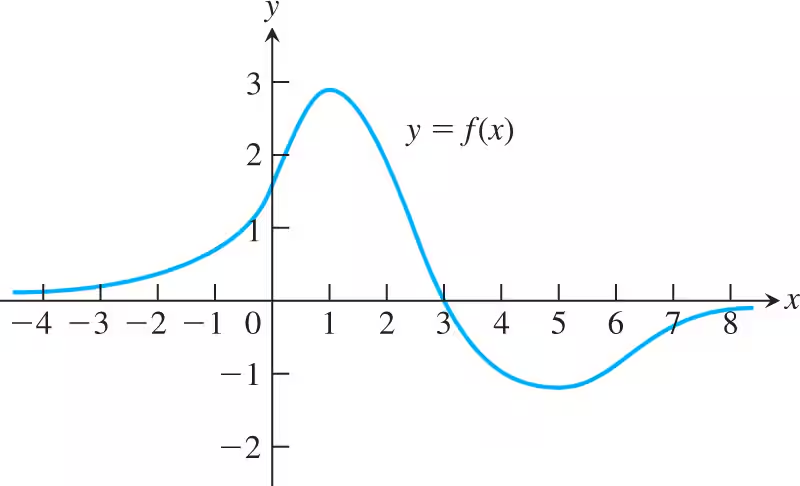
8. Using the function shown in the figure, and, for each initial estimate x_0, determine graphically what happens to the sequence of Newton’s method approximations
c. x_0=2
Problem 4.7.5c
Finding Antiderivatives
In Exercises 1–16, find an antiderivative for each function. Do as many as you can mentally. Check your answers by differentiation.
2 - 5 / x²
Problem 4.3.3c
Analyzing Functions from Derivatives
Answer the following questions about the functions whose derivatives are given in Exercises 1–14:
c. At what points, if any, does f assume local maximum or minimum values?
f′(x) = (x − 1)²(x + 2)
Problem 4.7.15c
Finding Antiderivatives
In Exercises 1–16, find an antiderivative for each function. Do as many as you can mentally. Check your answers by differentiation.
−π csc (πx/2) cot (πx/2)
Problem 4.7.1c
Finding Antiderivatives
In Exercises 1–16, find an antiderivative for each function. Do as many as you can mentally. Check your answers by differentiation.
x² − 2x + 1
Problem 4.7.101c
Finding displacement from an antiderivative of velocity
a. Suppose that the velocity of a body moving along the s-axis is
ds/dt = v = 9.8t − 3.
iii. Now find the body’s displacement from t = 1 to t = 3 given that s = s₀ when t = 0.
Problem 4.6.27c
[Technology Exercises] When solving Exercises 14–30, you may need to use appropriate technology (such as a calculator or a computer).
27. Converging to different zeros Use Newton's method to find the zeros of f(x)=4x^4-4x^2 using the given starting values.
c. x_0 = 0.8 and x_0 = 2, lying in (√2/2, ∞)
Problem 4.7.3c
Finding Antiderivatives
In Exercises 1–16, find an antiderivative for each function. Do as many as you can mentally. Check your answers by differentiation.
x⁻⁴ + 2x + 3
Problem 4.4.105c
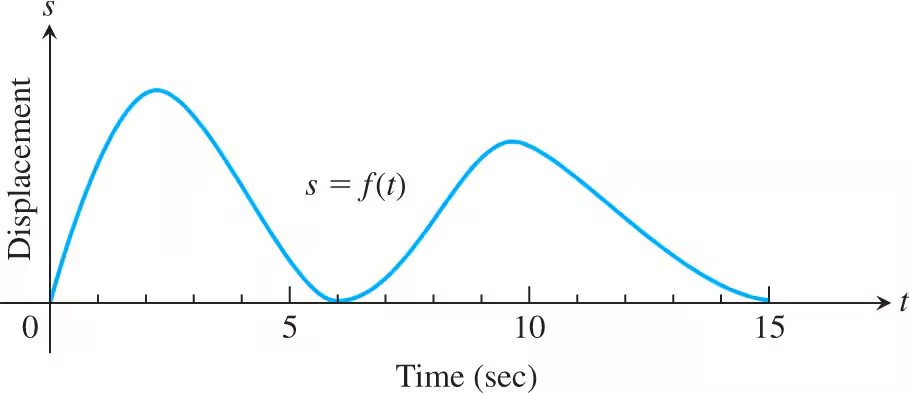
105. Motion Along a Line The graphs in Exercises 105 and 106 show the position s=f(t) of an object moving up and down on a coordinate line. At approximately what times is the (c) Acceleration equal to zero?
Problem 4.3.9c
Analyzing Functions from Derivatives
Answer the following questions about the functions whose derivatives are given in Exercises 1–14:
c. At what points, if any, does f assume local maximum or minimum values?
f′(x) = 1− 4/x², x ≠ 0
Problem 4.7.109c
Applications
Suppose that f(x) = d/dx (1 − √x) and g(x) = d/dx (x + 2).
Find:
∫[−f(x)] dx
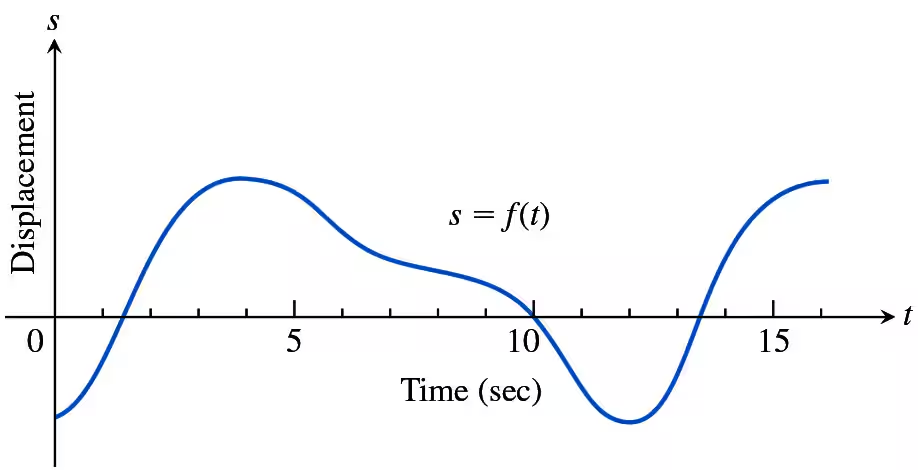
Problem 4.4.106d
106. Motion Along a Line The graphs in Exercises 105 and 106 show the position s=f(t) of an object moving up and down on a coordinate line. At approximately what times is the (d) When is the acceleration positive? Negative?