Ch. 24 - Amino Acids, Peptides, and Proteins
Wade - Organic Chemistry 9th Edition
Wade9th EditionOrganic ChemistryISBN: 9780135213728Not the one you use?Change textbook
Chapter 24, Problem 15

Give equations for the formation and hydrogenolysis of glutamine benzyl ester.

Verified step by step guidance
1
Write the structure of glutamine, which is an amino acid with the formula C5H10N2O3. Identify the functional groups: an amine (-NH2), a carboxylic acid (-COOH), and a side chain containing an amide (-CONH2).
To form the benzyl ester of glutamine, react the carboxylic acid group (-COOH) of glutamine with benzyl alcohol (C6H5CH2OH) in the presence of an acid catalyst (e.g., H2SO4) or a coupling agent like DCC (dicyclohexylcarbodiimide). This reaction forms the benzyl ester (-COOCH2C6H5) at the carboxylic acid group.
Write the chemical equation for the esterification reaction: Glutamine + Benzyl alcohol → Glutamine benzyl ester + Water. Use MathML to represent the structures of the reactants and products.
For the hydrogenolysis of glutamine benzyl ester, use a hydrogenation catalyst such as palladium on carbon (Pd/C) under a hydrogen atmosphere (H2). This reaction cleaves the benzyl ester group (-COOCH2C6H5) back to the carboxylic acid (-COOH) and forms toluene (C6H5CH3) as a byproduct.
Write the chemical equation for the hydrogenolysis reaction: Glutamine benzyl ester + H2 → Glutamine + Toluene. Use MathML to represent the structures of the reactants and products.

Verified video answer for a similar problem:

This video solution was recommended by our tutors as helpful for the problem above.
Video duration:
9m
Was this helpful?

Key Concepts

Here are the essential concepts you must grasp in order to answer the question correctly.

Formation of Glutamine Benzyl Ester

The formation of glutamine benzyl ester involves the reaction of glutamine, an amino acid, with benzyl alcohol in the presence of an acid catalyst. This process is known as esterification, where the carboxylic acid group of glutamine reacts with the hydroxyl group of benzyl alcohol, resulting in the formation of an ester bond and the release of water.
Recommended video:
1:01
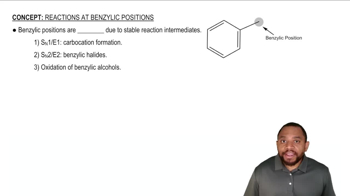
Reactions at Benzylic Positions Concept 1

Hydrogenolysis

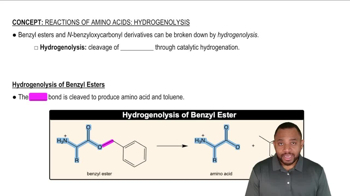
Hydrogenolysis is a chemical reaction that involves the cleavage of a bond in the presence of hydrogen, typically using a catalyst such as palladium or platinum. In the context of glutamine benzyl ester, hydrogenolysis would break the ester bond, converting the ester back into glutamine and benzyl alcohol. This reaction is important for the selective removal of protecting groups in organic synthesis.
Recommended video:
2:01
Reactions of Amino Acids: Hydrogenolysis Concept 1

Esterification and Hydrolysis Reactions

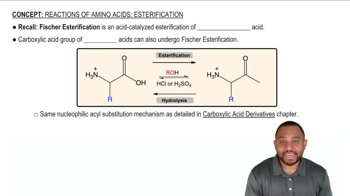
Esterification and hydrolysis are fundamental organic reactions involving the formation and breakdown of esters. Esterification is the process of forming an ester from an alcohol and a carboxylic acid, while hydrolysis is the reverse reaction, where an ester reacts with water to yield an alcohol and a carboxylic acid. Understanding these reactions is crucial for manipulating and synthesizing organic compounds in the laboratory.
Recommended video:
1:21
Reactions of Amino Acids: Esterification Concept 1