Ch. 2 - Acids and Bases; Functional Groups
Wade - Organic Chemistry 9th Edition
Wade9th EditionOrganic ChemistryISBN: 9780135213728Not the one you use?Change textbook
Chapter 2, Problem 36a

All of the following compounds can react as acids. Without using a table of acidities, rank them in order of increasing acidity. Explain your ranking.
a. CH3CH2SO3H
b. CH3CH2OH
c. CH3CH2COOH
d. CH3CHClCOOH
e. ClCH2CH2COOH

Verified step by step guidance
1
Identify the functional groups present in each compound. For example, CH3CH2SO3H contains a sulfonic acid group, CH3CH2OH contains an alcohol group, CH3CH2COOH contains a carboxylic acid group, CH3CHClCOOH contains a carboxylic acid group with a chlorine substituent, and ClCH2CH2COOH contains a carboxylic acid group with a chlorine substituent.
Understand the general acidity trend: sulfonic acids are typically stronger acids than carboxylic acids, which are stronger than alcohols. This is due to the stability of the conjugate base formed after deprotonation.
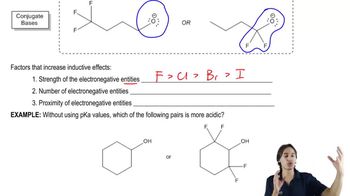
Consider the effect of electronegative substituents on acidity. Chlorine is an electronegative atom that can stabilize the conjugate base through inductive effects, increasing the acidity of the compound.
Compare the compounds with chlorine substituents: CH3CHClCOOH and ClCH2CH2COOH. The position of the chlorine atom relative to the acidic proton affects the inductive effect. Closer proximity generally results in greater stabilization of the conjugate base and increased acidity.
Rank the compounds based on the analysis: CH3CH2SO3H is likely the most acidic due to the sulfonic acid group, followed by the carboxylic acids with chlorine substituents (considering the position of chlorine), then CH3CH2COOH, and finally CH3CH2OH as the least acidic due to the alcohol group.

Verified video answer for a similar problem:

This video solution was recommended by our tutors as helpful for the problem above.
Video duration:
7m
Was this helpful?

Key Concepts

Here are the essential concepts you must grasp in order to answer the question correctly.

Acid Strength and Structure

Acid strength is influenced by the stability of the conjugate base formed after deprotonation. Factors such as electronegativity, resonance, and inductive effects play a crucial role in stabilizing the conjugate base, thereby increasing the acidity of the compound. Understanding these structural influences helps in predicting and ranking the acidity of different compounds.
Recommended video:
Guided course
03:09
The 3 factors that determine the strength of inductive effects.

Inductive Effect

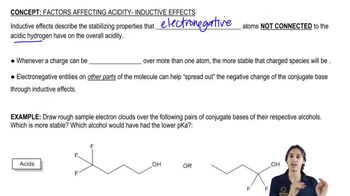
The inductive effect refers to the electron-withdrawing or electron-donating influence exerted by atoms or groups through sigma bonds. Electronegative atoms, like chlorine, can stabilize the conjugate base by pulling electron density away, enhancing acidity. This effect is crucial in comparing compounds with similar functional groups but different substituents.
Recommended video:
Guided course
01:47
Understanding the Inductive Effect.

Resonance Stabilization

Resonance stabilization occurs when the conjugate base can delocalize its negative charge over multiple atoms, increasing stability. Carboxylic acids, for example, benefit from resonance between the oxygen atoms, making them generally more acidic than alcohols. Recognizing resonance patterns is essential for assessing the relative acidity of organic compounds.
Recommended video:
Guided course
03:43
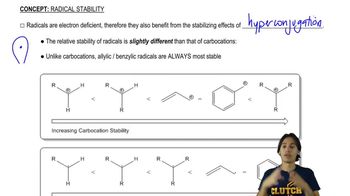
The radical stability trend.