Ch. 7 - Structure and Synthesis of Alkenes; Elimination
Wade - Organic Chemistry 9th Edition
Wade9th EditionOrganic ChemistryISBN: 9780135213728Not the one you use?Change textbook
Chapter 7, Problem 53

Predict the products of the following reactions. When more than one product is expected, predict which will be the major product.

Verified step by step guidance
1
Step 1: Recognize that the reaction involves alcohol dehydration using an acid catalyst (H2SO4 or H3PO4) and heat. This process typically follows the E1 mechanism, where the alcohol is protonated, forming a good leaving group (water), followed by carbocation formation and elimination.
Step 2: Analyze the structure of the alcohol in each case to determine the stability of the carbocation intermediate. More substituted carbocations (tertiary > secondary > primary) are more stable due to hyperconjugation and inductive effects.
Step 3: For each reaction, identify the major product by applying Zaitsev's rule, which states that the most substituted alkene will be the major product due to its greater stability.
Step 4: Consider any rearrangements that may occur during carbocation formation. For example, hydride or alkyl shifts can happen to form a more stable carbocation before elimination.
Step 5: Write the expected products for each reaction, ensuring to indicate the major product based on the stability of the alkene formed. For example, in cyclic systems, the double bond will likely form within the ring to maximize conjugation and stability.

Verified video answer for a similar problem:

This video solution was recommended by our tutors as helpful for the problem above.
Video duration:
13m
Was this helpful?

Key Concepts

Here are the essential concepts you must grasp in order to answer the question correctly.

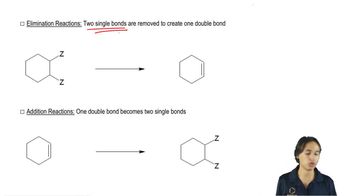
Elimination Reactions

Elimination reactions involve the removal of a small molecule from a larger one, typically resulting in the formation of a double bond. In organic chemistry, dehydration reactions, where water is eliminated, are common when alcohols are treated with acids under heat. Understanding the mechanism of elimination is crucial for predicting the products of the reactions shown.
Recommended video:
Guided course
00:40
Recognizing Elimination Reactions.

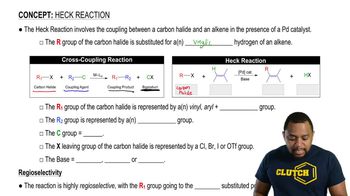
Regioselectivity

Regioselectivity refers to the preference of a chemical reaction to yield one structural isomer over others when multiple products are possible. In the context of the reactions presented, identifying the major product involves analyzing the stability of the potential products, often influenced by factors such as sterics and electronic effects. This concept is essential for predicting which product will dominate in the reaction.
Recommended video:
Guided course
05:09
Heck Reaction

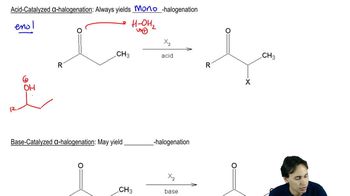
Acid-Catalyzed Reactions

Acid-catalyzed reactions utilize acids, such as sulfuric acid or phosphoric acid, to facilitate the transformation of reactants. These acids can protonate functional groups, making them more reactive and promoting elimination or rearrangement processes. Recognizing how acids influence reaction pathways is vital for understanding the outcomes of the reactions depicted in the question.
Recommended video:
Guided course
03:09
Acid Catalyzed