
Ch.4 - The Study of Chemical Reactions
Wade - Organic Chemistry 9th Edition
Wade9th EditionOrganic ChemistryISBN: 9780135213728Not the one you use?Change textbook
Chapter 4, Problem 36

Draw a reaction-energy diagram for a one-step exothermic reaction. Label the parts that represent the reactants, products, transition state, activation energy, and heat of reaction.

Verified step by step guidance
1
Start by drawing a graph with the x-axis representing the reaction coordinate (progress of the reaction) and the y-axis representing the energy of the system.
Plot the energy of the reactants as a point or a flat line on the left side of the graph. Label this as 'Reactants'.
Draw a peak to represent the transition state. The peak should be higher in energy than both the reactants and products. Label this peak as 'Transition State'.
Draw a line descending from the transition state to a lower energy level on the right side of the graph. This lower energy level represents the products. Label this as 'Products'.
Indicate the activation energy (Ea) as the energy difference between the reactants and the transition state, and the heat of reaction (ΔH) as the energy difference between the reactants and products. Label these appropriately on the diagram.

Verified video answer for a similar problem:

This video solution was recommended by our tutors as helpful for the problem above.
Video duration:
5m
Was this helpful?

Key Concepts

Here are the essential concepts you must grasp in order to answer the question correctly.

Reaction Energy Diagram

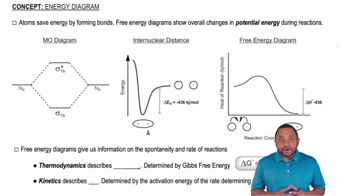
A reaction energy diagram visually represents the energy changes during a chemical reaction. It typically plots the energy of the system on the y-axis against the progress of the reaction on the x-axis. This diagram helps illustrate the energy levels of reactants, products, and the transition state, providing insight into the reaction's thermodynamics and kinetics.
Recommended video:
Guided course
06:07
Introduction to free energy diagrams.

Exothermic Reaction

An exothermic reaction is a type of chemical reaction that releases energy, usually in the form of heat, to the surroundings. In a reaction energy diagram, this is depicted by the products being at a lower energy level than the reactants. The difference in energy between the reactants and products is known as the heat of reaction, indicating the energy released during the process.
Recommended video:
Guided course
05:09
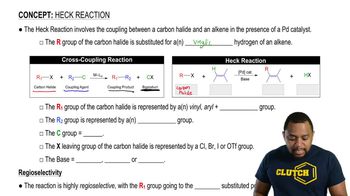
Heck Reaction

Activation Energy

Activation energy is the minimum energy required for a reaction to occur, represented in the reaction energy diagram as the energy barrier that must be overcome to reach the transition state. It is the difference in energy between the reactants and the transition state. Understanding activation energy is crucial for grasping how catalysts can lower this barrier, thereby increasing the reaction rate.
Recommended video:
Guided course
06:07
Introduction to free energy diagrams.
Related Practice
Textbook Question

Consider the following reaction-energy diagram.

a. Label the reactants and the products. Label the activation energy for the first step and the second step.

b. Is the overall reaction endothermic or exothermic? What is the sign of ΔH°?

c. Which points in the curve correspond to intermediates? Which correspond to transition states?

d. Label the transition state of the rate-limiting step. Does its structure resemble the reactants, the products, or an ­intermediate?

2438
views
Textbook Question

a. Draw an approximate reaction-energy diagram for the acid–base reaction of phenol (see below) with 1-molar aqueous sodium hydroxide solution.

b. On the same diagram, draw an approximate reaction-energy diagram for the acid–base reaction of tert-butyl alcohol (see below) with 1-molar aqueous sodium hydroxide solution.

1079
views
1
rank
Textbook Question

The following reaction is a common synthesis used in the organic chemistry laboratory course.

When we double the concentration of methoxide ion (CH3O), we find that the reaction rate doubles. When we triple the concentration of 1-bromobutane, we find that the reaction rate triples.

a. What is the order of this reaction with respect to 1-bromobutane? What is the order with respect to methoxide ion? Write the rate equation for this reaction. What is the overall order?

1195
views
1
rank
Textbook Question

Draw a reaction-energy diagram for a two-step endothermic reaction with a rate-limiting second step.

1879
views
Textbook Question

Treatment of tert-butyl alcohol with concentrated HCl gives tert-butyl chloride.

When the concentration of H+ is doubled, the reaction rate doubles. When the concentration of tert-butyl alcohol is tripled, the reaction rate triples. When the chloride ion concentration is quadrupled, however, the reaction rate is unchanged. Write the rate equation for this reaction.

1372
views
Textbook Question

When it is strongly heated, ethyl diazoacetate decomposes to give nitrogen gas and a carbene. Draw a Lewis structure of the carbene.

1483
views