

Ch. 14 - Ethers, Epoxides, and Thioethers
Wade - Organic Chemistry 9th Edition
Wade9th EditionOrganic ChemistryISBN: 9780135213728Not the one you use?Change textbook
Chapter 14, Problem 15c

Predict the products of the following reactions. An excess of acid is available in each case.
(c) anisole (methoxybenzene) + HBr

Verified step by step guidance
1
Identify the type of reaction taking place. In this case, since an excess of acid is available, consider the possibility of an acid-catalyzed reaction such as hydration, esterification, or hydrolysis.
Examine the structure of the reactants. Look for functional groups that are reactive in the presence of acid, such as alkenes, alcohols, or esters.
Determine the mechanism of the reaction. For example, if the reactant is an alkene, the reaction might proceed through an electrophilic addition mechanism where the acid protonates the alkene to form a carbocation intermediate.
Predict the formation of intermediates. In the case of a carbocation intermediate, consider possible rearrangements that could lead to a more stable carbocation.
Identify the final products by considering the stability of the intermediates and the possible nucleophiles present in the reaction mixture. For example, water could act as a nucleophile in an acid-catalyzed hydration reaction, leading to the formation of an alcohol.

Verified video answer for a similar problem:

This video solution was recommended by our tutors as helpful for the problem above.
Video duration:
4m
Was this helpful?

Key Concepts

Here are the essential concepts you must grasp in order to answer the question correctly.

Acid-Base Reactions

Acid-base reactions involve the transfer of protons (H+) between reactants. In organic chemistry, acids can donate protons, while bases accept them. Understanding the role of acids in promoting reactions, especially in the presence of excess acid, is crucial for predicting the products formed in various organic transformations.
Recommended video:
Guided course
02:49
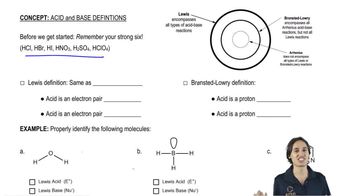
The Lewis definition of acids and bases.

Nucleophilic Substitution

Nucleophilic substitution is a fundamental reaction mechanism where a nucleophile attacks an electrophile, replacing a leaving group. This concept is essential for predicting products in reactions involving alkyl halides or other electrophilic centers, especially when acid catalysis can enhance the nucleophilicity of the attacking species.
Recommended video:
Guided course
01:47
Nucleophiles and Electrophiles can react in Substitution Reactions.

Rearrangement Reactions

Rearrangement reactions involve the structural reorganization of a molecule, often facilitated by acidic conditions. These reactions can lead to the formation of more stable products or different isomers. Recognizing when and how rearrangements occur is vital for accurately predicting the outcomes of organic reactions under acidic conditions.
Recommended video:
Guided course
06:28
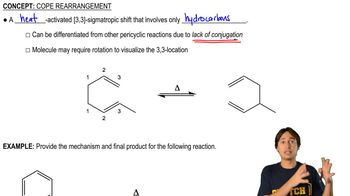
Definition of Cope Rearrangement