

Ch. 14 - Ethers, Epoxides, and Thioethers
Wade - Organic Chemistry 9th Edition
Wade9th EditionOrganic ChemistryISBN: 9780135213728Not the one you use?Change textbook
Chapter 14, Problem 15a,b,c

Predict the products of the following reactions. An excess of acid is available in each case.
(a) ethoxycyclohexane + HBr
(b) tetrahydropyran + HI
(c) anisole (methoxybenzene) + HBr

Verified step by step guidance
1
Step 1: Analyze the reaction conditions for each case. The presence of an excess of acid (HBr or HI) indicates that these are acid-catalyzed reactions, likely involving cleavage of ether bonds.
Step 2: For (a) ethoxycyclohexane + HBr, recognize that the ether bond (C-O-C) will be cleaved under acidic conditions. Protonation of the ether oxygen will occur first, making it a better leaving group. This will lead to the formation of cyclohexanol and ethyl bromide as products.
Step 3: For (b) tetrahydropyran + HI, note that tetrahydropyran is a cyclic ether. Under acidic conditions, the ether oxygen will be protonated, leading to ring opening. The products will be 1-iodohexane and water, as the iodide ion attacks the carbon adjacent to the oxygen.
Step 4: For (c) anisole (methoxybenzene) + HBr, recognize that anisole is an aromatic ether. The aromatic ring stabilizes the ether bond, making it less reactive. In this case, the reaction will not proceed under normal acidic conditions, and anisole will remain unchanged.
Step 5: Summarize the products: (a) cyclohexanol and ethyl bromide, (b) 1-iodohexane and water, (c) no reaction for anisole under these conditions.

Verified video answer for a similar problem:

This video solution was recommended by our tutors as helpful for the problem above.
Video duration:
10m
Was this helpful?

Key Concepts

Here are the essential concepts you must grasp in order to answer the question correctly.

Nucleophilic Substitution

Nucleophilic substitution is a fundamental reaction mechanism in organic chemistry where a nucleophile replaces a leaving group in a molecule. In the context of the reactions provided, the acid (HBr or HI) can protonate the ether oxygen, making the carbon atom bonded to the leaving group more electrophilic, facilitating the substitution process.
Recommended video:
Guided course
01:47
Nucleophiles and Electrophiles can react in Substitution Reactions.

Acid-Catalyzed Cleavage of Ethers

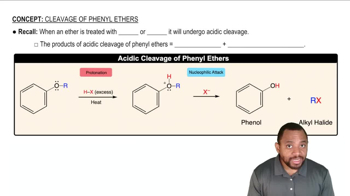
Ethers can undergo cleavage in the presence of strong acids, such as HBr or HI. The acid protonates the ether oxygen, leading to the formation of a more reactive intermediate that can break the C-O bond, resulting in the formation of alkyl halides. This is particularly relevant for predicting the products of the reactions involving ethoxycyclohexane and tetrahydropyran.
Recommended video:
1:45
Cleavage of Phenyl Ethers Concept 1

Electrophilic Aromatic Substitution

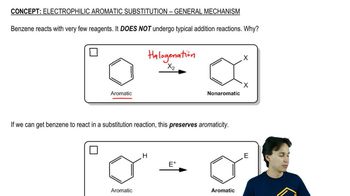
Electrophilic aromatic substitution is a reaction where an electrophile replaces a hydrogen atom on an aromatic ring. In the case of anisole reacting with HBr, the methoxy group activates the aromatic ring, making it more susceptible to electrophilic attack, which can lead to the formation of brominated products. Understanding this concept is crucial for predicting the outcome of the reaction.
Recommended video: