Ch. 14 - Ethers, Epoxides, and Thioethers
Wade - Organic Chemistry 9th Edition
Wade9th EditionOrganic ChemistryISBN: 9780135213728Not the one you use?Change textbook
Chapter 14, Problem 14a

Propose a mechanism for the following reaction.

Verified step by step guidance
1
Step 1: Protonation of the oxygen atom in tetrahydrofuran (THF) occurs when it reacts with HBr. The oxygen atom in THF is nucleophilic and can accept a proton from HBr, forming a positively charged oxonium ion.
Step 2: The oxonium ion undergoes cleavage of the C-O bond, leading to the formation of a carbocation intermediate. This step is facilitated by the excess HBr, which provides a highly acidic environment.
Step 3: The bromide ion (Br⁻), generated from the dissociation of HBr, acts as a nucleophile and attacks the carbocation, forming a brominated intermediate. This step results in the addition of one bromine atom to the molecule.
Step 4: The process repeats as excess HBr continues to protonate the remaining ether oxygen, leading to further cleavage and formation of another carbocation. The bromide ion attacks this carbocation, resulting in the addition of a second bromine atom.
Step 5: The final product, 1,4-dibromobutane, is formed after both bromine atoms are added to the molecule. The reaction proceeds under acidic conditions with excess HBr to ensure complete conversion of THF into the dibrominated product.

Verified video answer for a similar problem:

This video solution was recommended by our tutors as helpful for the problem above.
Video duration:
5m
Was this helpful?

Key Concepts

Here are the essential concepts you must grasp in order to answer the question correctly.

Electrophilic Addition

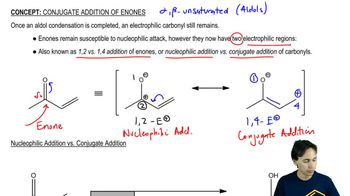
Electrophilic addition is a fundamental reaction mechanism in organic chemistry where an electrophile reacts with a nucleophile, resulting in the formation of a more saturated product. In the case of tetrahydrofuran reacting with HBr, the electrophile (H+) adds to the oxygen atom, leading to the formation of a more reactive intermediate that can further react with Br- to yield the final product.
Recommended video:
Guided course
09:23
1,2 vs 1,4 Addition

Ring Opening Mechanism

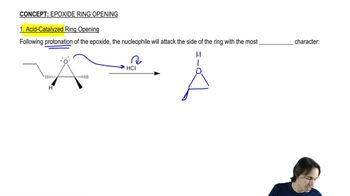
The ring opening mechanism involves the breaking of a cyclic structure to form a linear or acyclic product. In this reaction, tetrahydrofuran, a five-membered cyclic ether, undergoes ring opening upon protonation by HBr, allowing the formation of a linear dibrominated product. This process is crucial for understanding how cyclic ethers can be transformed into linear compounds.
Recommended video:
Guided course
04:34
Acid-Catalyzed Epoxide Ring-Opening

Regioselectivity

Regioselectivity refers to the preference of a chemical reaction to occur at one location over another in a molecule. In the reaction of tetrahydrofuran with excess HBr, regioselectivity is observed as the bromine atoms add to the 1 and 4 positions of the resulting linear structure, leading to the formation of 1,4-dibromobutane. Understanding regioselectivity is essential for predicting the outcome of reactions involving multiple reactive sites.
Recommended video:
Guided course
05:09
Heck Reaction