Ch. 15 - Conjugated Systems, Orbital Symmetry, and Ultraviolet Spectroscopy
Wade - Organic Chemistry 9th Edition
Wade9th EditionOrganic ChemistryISBN: 9780135213728Not the one you use?Change textbook
Chapter 15, Problem 2

In a strongly acidic solution, cyclohexa-1,4-diene tautomerizes to cyclohexa-1,3-diene. Propose a mechanism for this rearrangement, and explain why it is energetically favorable.

Verified step by step guidance
1
Step 1: Begin by understanding the concept of tautomerization. Tautomerization is a chemical reaction that results in the structural rearrangement of a compound, typically involving the migration of a hydrogen atom and a switch of a single bond and adjacent double bond. In this case, cyclohexa-1,4-diene is converting to cyclohexa-1,3-diene.
Step 2: Consider the role of the acidic solution. In a strongly acidic environment, protons (H⁺ ions) are abundant. These protons can facilitate the rearrangement by protonating the double bond, making it more susceptible to rearrangement.
Step 3: Propose the initial step of the mechanism. The protonation of cyclohexa-1,4-diene occurs at one of the double bonds, forming a carbocation intermediate. This is a key step as it sets the stage for the rearrangement.
Step 4: Describe the rearrangement process. The carbocation formed is stabilized by the migration of a hydrogen atom from the adjacent carbon, leading to the formation of a new double bond. This migration results in the shift from a 1,4-diene to a 1,3-diene structure.
Step 5: Explain the energetic favorability. The formation of cyclohexa-1,3-diene is energetically favorable due to increased conjugation. Conjugated dienes are more stable than isolated dienes because the delocalization of electrons across the conjugated system lowers the overall energy of the molecule.

Verified video answer for a similar problem:

This video solution was recommended by our tutors as helpful for the problem above.
Video duration:
5m
Was this helpful?

Key Concepts

Here are the essential concepts you must grasp in order to answer the question correctly.

Tautomerization

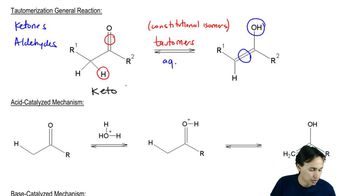
Tautomerization is a chemical process where a compound undergoes structural rearrangement, typically involving the migration of a hydrogen atom and a switch of a single bond and adjacent double bond. In the context of cyclohexa-1,4-diene, tautomerization involves the shift of double bonds to form cyclohexa-1,3-diene, which is facilitated by acidic conditions.
Recommended video:
Guided course
05:11
Tautomerization Mechanisms

Acid Catalysis

Acid catalysis involves the use of an acid to increase the rate of a chemical reaction. In this mechanism, the acid donates a proton to the cyclohexa-1,4-diene, stabilizing the intermediate and facilitating the rearrangement of bonds. The presence of a strong acid helps in the protonation of the diene, making the tautomerization process more favorable.
Recommended video:
2:50
Acid-Base Catalysis Concept 3

Energetic Favorability

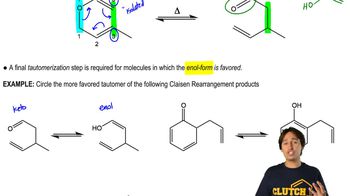
Energetic favorability refers to the tendency of a chemical reaction to proceed because it results in a lower energy state. Cyclohexa-1,3-diene is more stable than cyclohexa-1,4-diene due to the conjugation of double bonds, which lowers the overall energy of the molecule. This increased stability makes the tautomerization energetically favorable in acidic conditions.
Recommended video:
Guided course
03:15
When is Enol Tautomer Favored?