Ch. 15 - Conjugated Systems, Orbital Symmetry, and Ultraviolet Spectroscopy
Wade - Organic Chemistry 9th Edition
Wade9th EditionOrganic ChemistryISBN: 9780135213728Not the one you use?Change textbook
Chapter 15, Problem 5

When 3-bromo-1-methylcyclohexene undergoes solvolysis in hot ethanol, two products are formed. Propose a mechanism that accounts for both of these products.

Verified step by step guidance
1
Step 1: Identify the starting material, 3-bromo-1-methylcyclohexene, and recognize that the reaction occurs in hot ethanol, which acts as both a solvent and a nucleophile. The reaction mechanism is likely to proceed via solvolysis, which involves the loss of the bromide leaving group.
Step 2: The first step in the mechanism is the formation of a carbocation intermediate. The bromide group leaves, generating a secondary carbocation at the 3-position of the cyclohexene ring. This carbocation is stabilized by resonance with the double bond in the cyclohexene ring.
Step 3: Consider the possibility of carbocation rearrangement. The secondary carbocation can undergo a hydride shift to form a more stable tertiary carbocation at the 1-position of the cyclohexene ring. This rearrangement increases the stability of the intermediate.
Step 4: Ethanol, acting as a nucleophile, attacks the carbocation. Depending on whether the attack occurs at the secondary or tertiary carbocation, two different products can form. At the secondary carbocation, ethanol adds directly to the 3-position, forming the first product. At the tertiary carbocation, ethanol adds to the 1-position, forming the second product.
Step 5: Finally, proton transfer occurs to regenerate the neutral products. The proton from the ethanol group is removed, yielding the two final products: 1-ethoxy-1-methylcyclohexene and 3-ethoxy-1-methylcyclohexene.

Verified video answer for a similar problem:

This video solution was recommended by our tutors as helpful for the problem above.
Video duration:
6m
Was this helpful?

Key Concepts

Here are the essential concepts you must grasp in order to answer the question correctly.

Solvolysis

Solvolysis is a type of nucleophilic substitution reaction where a solvent acts as a nucleophile. In this case, ethanol (CH3CH2OH) serves as the solvent that attacks the electrophilic carbon atom of the 3-bromo-1-methylcyclohexene. The reaction typically involves the formation of a carbocation intermediate, which can lead to different products depending on the stability of the carbocation and the pathway taken.
Recommended video:
Guided course
08:16
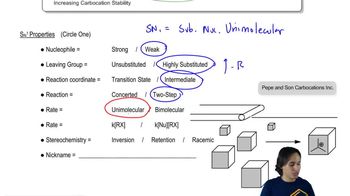
Understanding the properties of SN1.

Carbocation Stability

Carbocation stability is a crucial concept in organic chemistry, as it influences the reaction pathway and product formation. Tertiary carbocations are more stable than secondary or primary ones due to hyperconjugation and inductive effects. In the case of 3-bromo-1-methylcyclohexene, the formation of a stable carbocation allows for the possibility of rearrangement or different nucleophilic attacks, leading to multiple products.
Recommended video:
Guided course
05:58
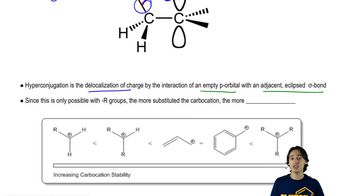
Determining Carbocation Stability

Nucleophilic Attack

Nucleophilic attack refers to the process where a nucleophile donates a pair of electrons to an electrophile, forming a new bond. In this reaction, the ethanol acts as a nucleophile, attacking the carbocation formed after the loss of bromide ion. The nature of the nucleophile and the structure of the carbocation can lead to different products, as seen in the formation of two distinct ethers in this solvolysis reaction.
Recommended video:
Guided course
08:27
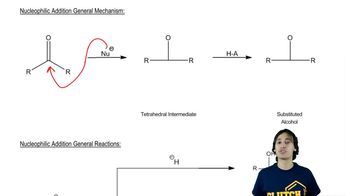
Nucleophilic Addition
Related Practice
Textbook Question

Propose a mechanism for each reaction, showing explicitly how the observed mixtures of products are formed.

c. cyclopenta-1,3-diene + Br2 → 3,4-dibromocyclopent-1-ene + 3,5-dibromocyclopent-1-ene

577
views

Textbook Question

Propose a mechanism for each reaction, showing explicitly how the observed mixtures of products are formed.

(b) 2-methylbut-3-en-2-ol + HBr → 1-bromo-3-methylbut-2-ene + 3-bromo-3-methylbut-1-ene

1784
views
Textbook Question

The central carbon atom of an allene is a member of two double bonds, and it has an interesting orbital arrangement that holds the two ends of the molecule at right angles to each other.

a. Draw an orbital diagram of allene, showing why the two ends are perpendicular.

b. Draw the two enantiomers of penta-2,3-diene. A model may be helpful.

2373
views
Textbook Question

Draw another resonance form for each of the substituted allylic cations shown in the preceding figure, showing how the positive charge is shared by another carbon atom. In each case, state whether your second resonance form is a more important or less important resonance contributor than the first structure. (Which structure places the positive charge on the more-substituted carbon atom?)

1223
views
Textbook Question

Treatment of an alkyl halide with AgNO3 in alcohol often promotes ionization.

Ag+ + R–Cl → AgCl + R+

When 4-chloro-2-methylhex-2-ene reacts with AgNO3 in ethanol, two isomeric ethers are formed. Suggest structures, and propose a mechanism for their formation

6947
views
1
rank
Textbook Question

In a strongly acidic solution, cyclohexa-1,4-diene tautomerizes to cyclohexa-1,3-diene. Propose a mechanism for this rearrangement, and explain why it is energetically favorable.

1601
views