Ch. 15 - Conjugated Systems, Orbital Symmetry, and Ultraviolet Spectroscopy
Wade - Organic Chemistry 9th Edition
Wade9th EditionOrganic ChemistryISBN: 9780135213728Not the one you use?Change textbook
Chapter 15, Problem 25i

Predict the products of the following reactions.
(i)

Verified step by step guidance
1
Step 1: Identify the reactants. The first reactant is furan, a five-membered aromatic ring containing an oxygen atom. The second reactant is a molecule with two aldehyde groups (-CHO) attached to a central alkyne (-C≡C-).
Step 2: Recognize the type of reaction. This reaction is likely a Diels-Alder reaction, where a conjugated diene (furan) reacts with a dienophile (the molecule containing the alkyne and aldehyde groups). The Diels-Alder reaction forms a six-membered ring by a [4+2] cycloaddition mechanism.
Step 3: Analyze the electron-withdrawing groups on the dienophile. The aldehyde groups (-CHO) are electron-withdrawing, which makes the alkyne more reactive as a dienophile. This enhances the likelihood of the cycloaddition reaction.
Step 4: Predict the product structure. The furan will act as the diene, and the alkyne will act as the dienophile. The reaction will form a new six-membered ring, incorporating the oxygen atom from furan and the carbon atoms from the alkyne. The aldehyde groups will remain attached to the newly formed ring.
Step 5: Consider stereochemistry. The Diels-Alder reaction typically proceeds with stereospecificity, meaning the relative orientation of substituents in the product will depend on the approach of the reactants. The aldehyde groups will likely end up in a cis configuration due to the concerted nature of the reaction.

Verified video answer for a similar problem:

This video solution was recommended by our tutors as helpful for the problem above.
Video duration:
4m
Was this helpful?

Key Concepts

Here are the essential concepts you must grasp in order to answer the question correctly.

Diels-Alder Reaction

The Diels-Alder reaction is a [4+2] cycloaddition reaction between a conjugated diene and a dienophile, resulting in the formation of a six-membered ring. This reaction is a key method in organic synthesis for constructing cyclic compounds and is characterized by its stereospecificity and regioselectivity.
Recommended video:
Guided course
04:02
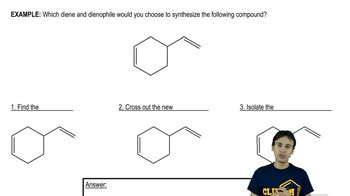
Diels-Alder Retrosynthesis

Electrophilicity of Dienophiles

Dienophiles are typically electron-deficient alkenes or alkynes that react with electron-rich dienes in the Diels-Alder reaction. The presence of electron-withdrawing groups, such as carbonyls (C=O), enhances the electrophilicity of the dienophile, making it more reactive towards the diene.
Recommended video:
Guided course
03:
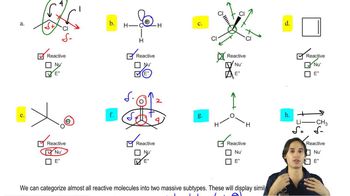
Nucleophile or Electrophile

Stereochemistry of Products

The stereochemistry of the products formed in the Diels-Alder reaction is crucial, as the reaction is stereospecific. The relative orientation of substituents on the diene and dienophile is preserved in the product, leading to specific stereochemical outcomes that can influence the properties and reactivity of the resulting compound.
Recommended video:
1:38
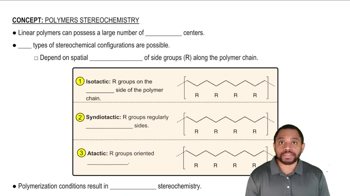
Polymer Stereochemistry Concept 1