Ch. 15 - Conjugated Systems, Orbital Symmetry, and Ultraviolet Spectroscopy
Wade - Organic Chemistry 9th Edition
Wade9th EditionOrganic ChemistryISBN: 9780135213728Not the one you use?Change textbook
Chapter 15, Problem 25h

Predict the products of the following reactions.
(h) cyclopentadiene + methyl acrylate, CH2=CH–COOCH3

Verified step by step guidance
1
Step 1: Recognize the reaction type. Cyclopentadiene is a conjugated diene, and methyl acrylate (CH2=CH–COOCH3) is an alkene with an electron-withdrawing ester group. This setup suggests a Diels-Alder reaction, which is a [4+2] cycloaddition reaction between a diene and a dienophile.
Step 2: Analyze the diene and dienophile. Cyclopentadiene has two conjugated double bonds, making it an excellent diene. Methyl acrylate has a double bond adjacent to the ester group, which acts as an electron-withdrawing group, enhancing its reactivity as a dienophile.
Step 3: Determine the regioselectivity and stereochemistry. In the Diels-Alder reaction, the electron-withdrawing group (COOCH3) on the dienophile will typically orient itself to maximize interaction with the electron-rich diene. This leads to predictable regioselectivity in the product.
Step 4: Draw the cyclic product. The reaction forms a six-membered ring as the diene and dienophile combine. The ester group (COOCH3) will be attached to one of the carbons in the newly formed ring, and the stereochemistry will depend on the approach of the dienophile.
Step 5: Verify the product structure. Ensure that the product satisfies the rules of the Diels-Alder reaction, including conservation of the number of atoms and proper placement of substituents. The final product will be a bicyclic compound with the ester group attached to the appropriate position on the ring.

Verified video answer for a similar problem:

This video solution was recommended by our tutors as helpful for the problem above.
Video duration:
6m
Was this helpful?

Key Concepts

Here are the essential concepts you must grasp in order to answer the question correctly.

Diels-Alder Reaction

The Diels-Alder reaction is a [4+2] cycloaddition reaction between a conjugated diene and a dienophile, resulting in the formation of a six-membered ring. In this case, cyclopentadiene acts as the diene, while methyl acrylate serves as the dienophile. This reaction is characterized by its stereospecificity and is widely used in organic synthesis to create complex cyclic structures.
Recommended video:
Guided course
04:02
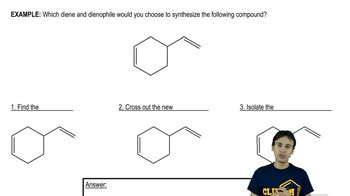
Diels-Alder Retrosynthesis

Conjugated Dienes

Conjugated dienes are compounds that contain two double bonds separated by a single bond, allowing for resonance stabilization. This structure enhances their reactivity in cycloaddition reactions, such as the Diels-Alder reaction. Cyclopentadiene, with its two double bonds, is a classic example of a conjugated diene, making it highly reactive towards dienophiles like methyl acrylate.
Recommended video:
Guided course
03:27
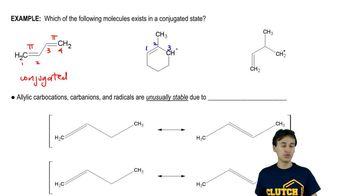
Conjugated states

Dienophile

A dienophile is a compound that contains a double bond and reacts with a diene in a Diels-Alder reaction. Dienophiles are typically electron-deficient, which makes them more reactive towards the electron-rich diene. Methyl acrylate, with its carbon-carbon double bond and electron-withdrawing ester group, is an effective dienophile that can participate in the cycloaddition with cyclopentadiene.
Recommended video:
Guided course
09:48
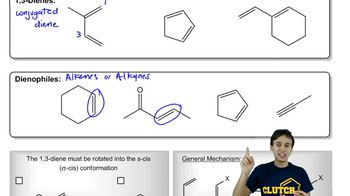
General Features