Ch. 15 - Conjugated Systems, Orbital Symmetry, and Ultraviolet Spectroscopy
Wade - Organic Chemistry 9th Edition
Wade9th EditionOrganic ChemistryISBN: 9780135213728Not the one you use?Change textbook
Chapter 15, Problem 25f

Predict the products of the following reactions.
(f) hexa-1,3,5-triene + bromine in CCl4

Verified step by step guidance
1
Analyze the structure of hexa-1,3,5-triene. It is a conjugated triene with alternating double and single bonds, specifically at positions 1, 3, and 5 of the hexane chain.
Understand the reagent and solvent: Bromine (Br₂) in carbon tetrachloride (CCl₄) is a non-polar solvent, and this reaction typically involves an electrophilic addition mechanism.
Identify the reaction type: Bromine reacts with conjugated dienes or trienes through an electrophilic addition mechanism. The π-electrons of the conjugated system attack the bromine molecule, forming a bromonium ion intermediate.
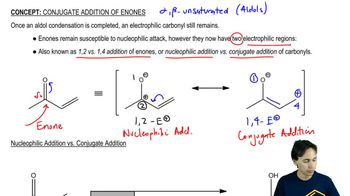
Determine the regioselectivity: In conjugated systems, the addition of bromine can occur at the 1,4-positions (conjugate addition) or the 1,2-positions (direct addition). The major product is often the 1,4-addition product due to the stability of the intermediate carbocation.
Predict the products: The reaction will yield two main products: the 1,2-addition product and the 1,4-addition product. The 1,4-addition product is typically favored under these conditions. Represent the products by adding bromine atoms to the appropriate positions on the hexa-1,3,5-triene structure.

Verified video answer for a similar problem:

This video solution was recommended by our tutors as helpful for the problem above.
Video duration:
3m
Was this helpful?

Key Concepts

Here are the essential concepts you must grasp in order to answer the question correctly.

Electrophilic Addition

Electrophilic addition is a fundamental reaction mechanism in organic chemistry where an electrophile reacts with a nucleophile, typically involving alkenes or alkynes. In the case of hexa-1,3,5-triene, the double bonds act as nucleophiles, attacking the electrophilic bromine molecule. This results in the formation of a more stable product, often a dibromide, as the π-bonds are converted into σ-bonds.
Recommended video:
Guided course
09:23
1,2 vs 1,4 Addition

Bromination of Alkenes

Bromination is a specific type of electrophilic addition where bromine (Br2) adds across the double bonds of alkenes. In non-polar solvents like CCl4, bromine remains intact and can add to the double bonds without undergoing significant side reactions. The addition typically occurs in a trans fashion, leading to vicinal dibromides, which are important in synthetic organic chemistry.
Recommended video:
Guided course
00:54
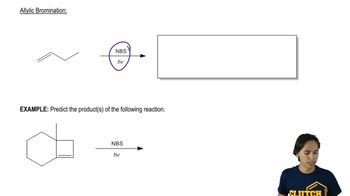
Mechanism of Allylic Bromination.

Regioselectivity and Stereochemistry

Regioselectivity refers to the preference of a chemical reaction to yield one structural isomer over others when multiple possibilities exist. In the bromination of hexa-1,3,5-triene, the reaction can lead to different products depending on which double bond is attacked. Stereochemistry also plays a role, as the addition of bromine can result in different stereoisomers, influencing the final product's properties and reactivity.
Recommended video:
1:38
Polymer Stereochemistry Concept 1