Ch. 15 - Conjugated Systems, Orbital Symmetry, and Ultraviolet Spectroscopy
Wade - Organic Chemistry 9th Edition
Wade9th EditionOrganic ChemistryISBN: 9780135213728Not the one you use?Change textbook
Chapter 15, Problem 7c

Propose a mechanism for each reaction, showing explicitly how the observed mixtures of products are formed.
c. cyclopenta-1,3-diene + Br2 → 3,4-dibromocyclopent-1-ene + 3,5-dibromocyclopent-1-ene

Verified step by step guidance
1
Identify the type of reaction: This reaction involves the addition of bromine (Br₂) to cyclopenta-1,3-diene, which is a conjugated diene. The reaction proceeds via an electrophilic addition mechanism, and the observed products suggest that both 1,2- and 1,4-addition occur.
Step 1: Activation of bromine molecule: The bromine molecule (Br₂) becomes polarized as it approaches the electron-rich π-system of cyclopenta-1,3-diene. This polarization creates a partial positive charge on one bromine atom, making it electrophilic.
Step 2: Formation of the bromonium ion intermediate: The π-electrons of one of the double bonds in cyclopenta-1,3-diene attack the electrophilic bromine atom, leading to the formation of a cyclic bromonium ion intermediate. This intermediate is stabilized by the conjugated system of the diene.
Step 3: Nucleophilic attack by bromide ion: The bromide ion (Br⁻), generated in the previous step, acts as a nucleophile and attacks the bromonium ion. Depending on the site of attack, two possible products can form: (a) 1,2-addition product (3,4-dibromocyclopent-1-ene) or (b) 1,4-addition product (3,5-dibromocyclopent-1-ene).
Step 4: Analyze the product distribution: The observed mixture of products arises because the bromide ion can attack at different positions of the bromonium ion intermediate. The relative stability of the products and the reaction conditions (e.g., temperature) influence the ratio of 1,2- and 1,4-addition products.

Verified video answer for a similar problem:

This video solution was recommended by our tutors as helpful for the problem above.
Video duration:
2m
Was this helpful?

Key Concepts

Here are the essential concepts you must grasp in order to answer the question correctly.

Electrophilic Addition Reactions

Electrophilic addition reactions involve the addition of an electrophile to a nucleophile, typically across a double bond. In the case of cyclopenta-1,3-diene reacting with Br2, the diene acts as a nucleophile, attacking the bromine molecule, which is an electrophile. This process leads to the formation of a cyclic bromonium ion intermediate, which is crucial for understanding the subsequent product formation.
Recommended video:
Guided course
05:39
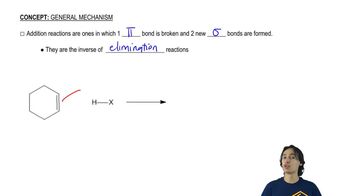
Features of Addition Mechanisms.

Stability of Reaction Intermediates

The stability of reaction intermediates, such as carbocations or bromonium ions, significantly influences the outcome of organic reactions. In this reaction, the formation of a bromonium ion allows for the rearrangement and stabilization of the intermediate, leading to different product distributions. The stability of these intermediates can dictate the regioselectivity of the final products, such as 3,4-dibromocyclopent-1-ene and 3,5-dibromocyclopent-1-ene.
Recommended video:
Guided course
04:31
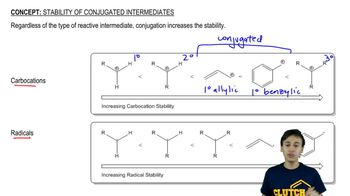
Stability of Conjugated Intermediates

Regioselectivity in Electrophilic Additions

Regioselectivity refers to the preference of a chemical reaction to yield one structural isomer over others. In the reaction of cyclopenta-1,3-diene with Br2, the formation of two different dibrominated products arises from the regioselective attack of the bromide ion on the bromonium ion intermediate. Understanding the factors that influence regioselectivity, such as sterics and electronic effects, is essential for predicting the product distribution in this reaction.
Recommended video:
Guided course
09:23
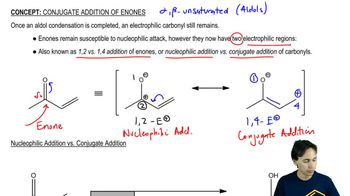
1,2 vs 1,4 Addition
Related Practice
Textbook Question

Propose a mechanism for each reaction, showing explicitly how the observed mixtures of products are formed.

(e) 3-chlorobut-1-ene + AgNO3, H2O → but-2-en-1-ol + but-3-en-2-ol

892
views

Textbook Question

When Br2 is added to buta-1,3-diene at –15 °C, the product mixture contains 60% of product A and 40% of product B. When the same reaction takes place at 60 °C, the product ratio is 10% A and 90% B.

a. Propose structures for products A and B. (Hint: In many cases, an allylic carbocation is more stable than a bromonium ion.)

b. Propose a mechanism to account for formation of both A and B.

c. Show why A predominates at –15 °C and B predominates at 60 °C.

1058
views
Textbook Question

When 3-bromo-1-methylcyclohexene undergoes solvolysis in hot ethanol, two products are formed. Propose a mechanism that accounts for both of these products.

2569
views
Textbook Question

Propose a mechanism for each reaction, showing explicitly how the observed mixtures of products are formed.

(b) 2-methylbut-3-en-2-ol + HBr → 1-bromo-3-methylbut-2-ene + 3-bromo-3-methylbut-1-ene

1784
views
Textbook Question

When Br2 is added to buta-1,3-diene at –15 °C, the product mixture contains 60% of product A and 40% of product B. When the same reaction takes place at 60 °C, the product ratio is 10% A and 90% B.

d. If you had a solution of pure A, and its temperature were raised to 60 °C, what would you expect to happen? Propose a mechanism to support your prediction.

758
views
Textbook Question

Treatment of an alkyl halide with AgNO3 in alcohol often promotes ionization.

Ag+ + R–Cl → AgCl + R+

When 4-chloro-2-methylhex-2-ene reacts with AgNO3 in ethanol, two isomeric ethers are formed. Suggest structures, and propose a mechanism for their formation

6947
views
1
rank