
Ch. 17 - Reactions of Aromatic Compounds
Wade - Organic Chemistry 9th Edition
Wade9th EditionOrganic ChemistryISBN: 9780135213728Not the one you use?Change textbook
Chapter 17, Problem 60e

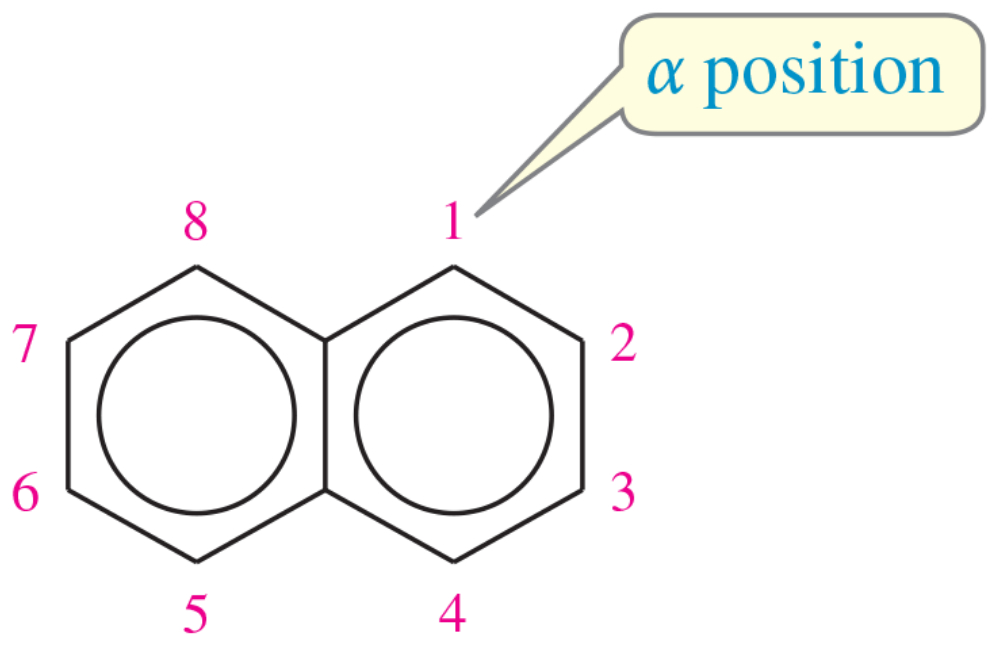
Electrophilic aromatic substitution usually occurs at the 1-position of naphthalene, also called the 1-position. Predict the major products of the reactions of naphthalene with the following reagents.

(e) cyclohexanol and BF3

Verified step by step guidance
1
Step 1: Understand the reaction type. The problem involves electrophilic aromatic substitution, which is a reaction where an electrophile replaces a hydrogen atom on an aromatic ring. Naphthalene is the aromatic compound in this case.
Step 2: Identify the reagents. Cyclohexanol and BF3 are provided as reagents. BF3 acts as a Lewis acid, which can activate cyclohexanol to form a carbocation. This carbocation will serve as the electrophile in the reaction.
Step 3: Determine the site of substitution. In naphthalene, the alpha position (1-position) is more reactive due to its higher electron density and stability of the intermediate carbocation formed during the reaction. Thus, substitution is expected to occur at the alpha position.
Step 4: Predict the product formation. The carbocation generated from cyclohexanol will attack the alpha position of naphthalene, leading to the formation of a new bond between the naphthalene ring and the cyclohexyl group.
Step 5: Consider resonance stabilization. After the electrophilic attack, the intermediate formed will undergo resonance stabilization, ensuring the aromaticity of the naphthalene ring is restored in the final product.

Verified video answer for a similar problem:

This video solution was recommended by our tutors as helpful for the problem above.
Video duration:
2m
Was this helpful?

Key Concepts

Here are the essential concepts you must grasp in order to answer the question correctly.

Electrophilic Aromatic Substitution (EAS)

Electrophilic Aromatic Substitution is a fundamental reaction in organic chemistry where an electrophile replaces a hydrogen atom on an aromatic ring. This reaction is crucial for modifying aromatic compounds, allowing for the introduction of various functional groups. The mechanism involves the formation of a sigma complex, where the aromaticity is temporarily lost, followed by deprotonation to restore aromaticity.
Recommended video:

Naphthalene Structure and Reactivity

Naphthalene is a polycyclic aromatic hydrocarbon consisting of two fused benzene rings. Its structure allows for electrophilic substitution primarily at the 1-position (α position) and 2-position (β position). The reactivity of naphthalene is influenced by its electron-rich nature, making it susceptible to electrophiles, with the α position being favored due to steric and electronic factors.
Recommended video:
Guided course
01:17
Reactivity of Molecules

Role of Lewis Acids in EAS

Lewis acids, such as BF3, are often used in electrophilic aromatic substitution reactions to enhance the electrophilicity of the reacting species. In the presence of a Lewis acid, the electrophile can become more reactive, facilitating the substitution process. This is particularly important when the electrophile is weak, as the Lewis acid can stabilize the transition state and promote the reaction.
Recommended video:
3:22
EAS Reactions of Pyridine Concept 3
Related Practice
Textbook Question

The most common selective herbicide for killing broadleaf weeds is 2,4-dichlorophenoxyacetic acid (2,4-D). Show how you would synthesize 2,4-D from benzene, chloroacetic acid (ClCH2COOH), and any necessary reagents and solvents.

1579
views
Textbook Question

Furan undergoes electrophilic aromatic substitution more readily than benzene; mild reagents and conditions are sufficient. For example, furan reacts with bromine to give 2-bromofuran.

a. Propose mechanisms for the bromination of furan at the 2-position and at the 3-position. Draw the resonance forms of each sigma complex, and compare their stabilities.

3491
views
Textbook Question

Furan undergoes electrophilic aromatic substitution more readily than benzene; mild reagents and conditions are sufficient. For example, furan reacts with bromine to give 2-bromofuran.

b. Explain why furan undergoes bromination (and other electrophilic aromatic substitutions) primarily at the 2-position.

3507
views
Textbook Question

Electrophilic aromatic substitution usually occurs at the 1-position of naphthalene, also called the a position. Predict the major products of the reactions of naphthalene with the following reagents.

(d) isobutylene and HF

553
views
Textbook Question

α-Tetralone undergoes Birch reduction to give an excellent yield of a single product. Predict the structure of the product, and propose a mechanism for its formation.

1153
views
Textbook Question

Electrophilic aromatic substitution usually occurs at the 1-position of naphthalene, also called the a position. Predict the major products of the reactions of naphthalene with the following reagents.

(a) HNO3, H2SO4

(b) Br2, FeBr3

(c) CH3CH2COCl, AlCl3

1346
views