
Ch. 17 - Reactions of Aromatic Compounds
Wade - Organic Chemistry 9th Edition
Wade9th EditionOrganic ChemistryISBN: 9780135213728Not the one you use?Change textbook
Chapter 17, Problem 64b

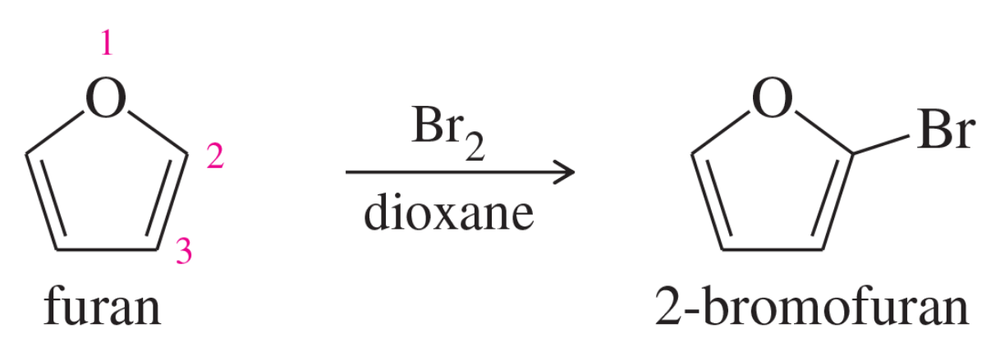
Furan undergoes electrophilic aromatic substitution more readily than benzene; mild reagents and conditions are sufficient. For example, furan reacts with bromine to give 2-bromofuran.
Furan structure with numbered positions, showing bromination reaction to form 2-bromofuran in dioxane.
b. Explain why furan undergoes bromination (and other electrophilic aromatic substitutions) primarily at the 2-position.

Verified step by step guidance
1
Step 1: Begin by understanding the structure of furan. Furan is a five-membered aromatic ring containing one oxygen atom. The aromaticity of furan arises from the delocalization of π-electrons, including the lone pair on the oxygen atom, which contributes to the conjugated π-system.
Step 2: Recognize that electrophilic aromatic substitution (EAS) occurs more readily in furan compared to benzene due to the electron-donating nature of the oxygen atom. The oxygen atom increases the electron density in the ring, making it more reactive toward electrophiles like bromine.
Step 3: Analyze the regioselectivity of the reaction. When furan undergoes bromination, the electrophile (Br⁺) preferentially attacks the 2-position of the ring. This preference is due to the stability of the intermediate carbocation formed during the reaction. Substitution at the 2-position allows for resonance stabilization of the carbocation, involving the oxygen atom's lone pair.
Step 4: Compare the resonance structures for substitution at the 2-position versus the 3-position. Substitution at the 2-position generates three resonance structures, two of which involve the oxygen atom directly stabilizing the positive charge. Substitution at the 3-position generates fewer resonance structures, and the positive charge is less effectively stabilized.
Step 5: Conclude that the enhanced stability of the intermediate carbocation when bromination occurs at the 2-position explains the regioselectivity of the reaction. This is why furan undergoes electrophilic aromatic substitution primarily at the 2-position, resulting in the formation of 2-bromofuran.

Verified video answer for a similar problem:

This video solution was recommended by our tutors as helpful for the problem above.
Video duration:
14m
Was this helpful?

Key Concepts

Here are the essential concepts you must grasp in order to answer the question correctly.

Electrophilic Aromatic Substitution (EAS)

Electrophilic Aromatic Substitution is a fundamental reaction in organic chemistry where an electrophile replaces a hydrogen atom on an aromatic ring. This process is facilitated by the electron-rich nature of the aromatic system, which stabilizes the formation of a carbocation intermediate. The reaction typically requires mild conditions, especially for more reactive aromatic compounds like furan, which can undergo substitution more readily than benzene.
Recommended video:

Reactivity of Furan

Furan is a five-membered aromatic heterocycle containing oxygen, which contributes to its increased reactivity compared to benzene. The presence of the electronegative oxygen atom enhances the electron density of the ring, making it more susceptible to electrophilic attack. This increased reactivity allows furan to undergo electrophilic aromatic substitution with milder reagents and conditions, such as bromination.
Recommended video:
1:42
Addition Reactions of Furan Concept 1

Position of Substitution in Furan

In furan, electrophilic substitution primarily occurs at the 2-position due to the stability of the resulting carbocation intermediate. When an electrophile attacks the 2-position, the positive charge can be delocalized over the aromatic system, leading to a more stable product. This preference for the 2-position is a result of the electronic effects of the oxygen atom and the resonance structures that stabilize the intermediate formed during the reaction.
Recommended video:
3:26
Directing Effects in Substituted Pyrroles, Furans, and Thiophenes Concept 2
Related Practice
Textbook Question

The most common selective herbicide for killing broadleaf weeds is 2,4-dichlorophenoxyacetic acid (2,4-D). Show how you would synthesize 2,4-D from benzene, chloroacetic acid (ClCH2COOH), and any necessary reagents and solvents.

1579
views
Textbook Question

Furan undergoes electrophilic aromatic substitution more readily than benzene; mild reagents and conditions are sufficient. For example, furan reacts with bromine to give 2-bromofuran.

a. Propose mechanisms for the bromination of furan at the 2-position and at the 3-position. Draw the resonance forms of each sigma complex, and compare their stabilities.

3491
views
Textbook Question

Electrophilic aromatic substitution usually occurs at the 1-position of naphthalene, also called the 1-position. Predict the major products of the reactions of naphthalene with the following reagents.

(e) cyclohexanol and BF3

694
views
Textbook Question

Unlike most other electrophilic aromatic substitutions, sulfonation is often reversible (see Section 17-4). When one sample of toluene is sulfonated at 0 °C and another sample is sulfonated at 100 °C, the following ratios of substitution products result:

a. Explain the change in the product ratios when the temperature is increased.

b. Predict what will happen when the product mixture from the reaction at 0 °C is heated to 100 °C.

738
views
Textbook Question

(a) Draw the three isomers of benzenedicarboxylic acid.

(b) The isomers have melting points of 210 °C, 343 °C, and 427 °C. Nitration of the isomers at all possible positions was once used to determine their structures. The isomer that melts at 210 °C gives two mononitro isomers. The isomer that melts at 343 °C gives three mononitro isomers. The isomer that melts at 427 °C gives only one mononitro isomer. Show which isomer has which melting point.

1338
views
Textbook Question

Unlike most other electrophilic aromatic substitutions, sulfonation is often reversible (see Section 17-4). When one sample of toluene is sulfonated at 0 °C and another sample is sulfonated at 100 °C, the following ratios of substitution products result:

c. Because the SO3H group can be added to a benzene ring and removed later, it is sometimes called a blocking group. Show how 2,6-dibromotoluene can be made from toluene using sulfonation and desulfonation as intermediate steps in the synthesis.

1265
views