
Ch. 17 - Reactions of Aromatic Compounds
Wade - Organic Chemistry 9th Edition
Wade9th EditionOrganic ChemistryISBN: 9780135213728Not the one you use?Change textbook
Chapter 17, Problem 64a

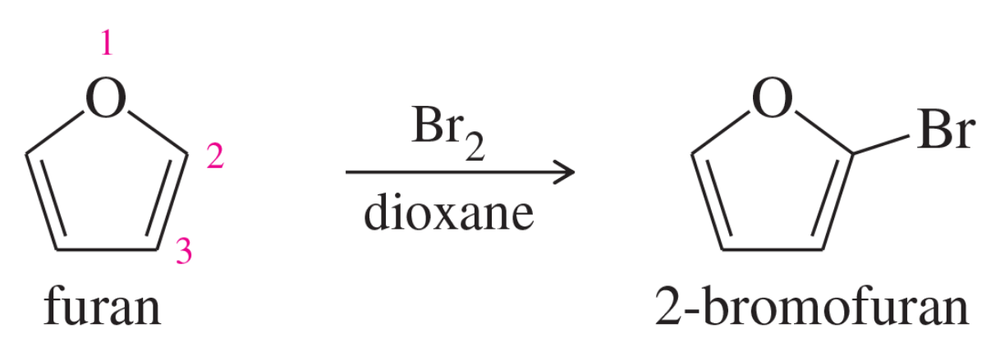
Furan undergoes electrophilic aromatic substitution more readily than benzene; mild reagents and conditions are sufficient. For example, furan reacts with bromine to give 2-bromofuran.
Furan structure with numbered positions, showing bromination reaction to form 2-bromofuran in dioxane.
a. Propose mechanisms for the bromination of furan at the 2-position and at the 3-position. Draw the resonance forms of each sigma complex, and compare their stabilities.

Verified step by step guidance
1
Step 1: Begin by understanding the reaction. Furan undergoes electrophilic aromatic substitution with bromine in dioxane to form 2-bromofuran. This reaction involves the formation of a sigma complex (arenium ion) as an intermediate.
Step 2: Propose the mechanism for bromination at the 2-position. The bromine molecule (Br₂) is polarized by the solvent or a catalyst, generating an electrophilic bromine species (Br⁺). Furan's electron-rich aromatic ring attacks Br⁺ at the 2-position, forming a sigma complex. Draw resonance structures for this sigma complex, showing delocalization of the positive charge over the ring.
Step 3: Propose the mechanism for bromination at the 3-position. Similarly, the polarized bromine species (Br⁺) is attacked by the aromatic ring at the 3-position, forming a sigma complex. Draw resonance structures for this sigma complex, showing delocalization of the positive charge over the ring.
Step 4: Compare the stabilities of the sigma complexes formed at the 2-position and the 3-position. The sigma complex formed at the 2-position is more stable because the positive charge can be delocalized onto the oxygen atom, which is highly electronegative and stabilizes the charge. In contrast, the sigma complex at the 3-position does not benefit from this stabilization.
Step 5: Conclude that bromination occurs preferentially at the 2-position due to the greater stability of the sigma complex formed at this position. This explains why 2-bromofuran is the major product of the reaction.

Verified video answer for a similar problem:

This video solution was recommended by our tutors as helpful for the problem above.
Video duration:
7m
Was this helpful?

Key Concepts

Here are the essential concepts you must grasp in order to answer the question correctly.

Electrophilic Aromatic Substitution (EAS)

Electrophilic Aromatic Substitution is a fundamental reaction in organic chemistry where an electrophile replaces a hydrogen atom on an aromatic ring. This process involves the formation of a sigma complex (also known as an arenium ion), where the aromaticity of the ring is temporarily lost. The stability of the sigma complex is influenced by the substituents on the ring and the nature of the electrophile, which can dictate the position of substitution.
Recommended video:

Resonance and Stability of Sigma Complexes

Resonance refers to the delocalization of electrons within a molecule, allowing for multiple valid Lewis structures. In the context of sigma complexes formed during EAS, resonance stabilizes the intermediate by distributing the positive charge over several atoms. The stability of these complexes can be compared by analyzing their resonance forms; more resonance forms typically indicate greater stability, influencing the likelihood of substitution at specific positions on the aromatic ring.
Recommended video:
Guided course
05:02
Coordination Complexes

Position of Substitution in Furan

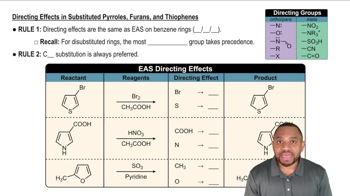
Furan is a five-membered aromatic heterocycle that exhibits unique reactivity compared to benzene due to the presence of an electronegative oxygen atom. This affects the electron density of the ring, making certain positions more favorable for electrophilic attack. In furan, the 2-position is more nucleophilic than the 3-position, leading to preferential substitution at the 2-position during electrophilic aromatic substitution reactions, as evidenced by the formation of 2-bromofuran.
Recommended video:
3:26
Directing Effects in Substituted Pyrroles, Furans, and Thiophenes Concept 2
Related Practice
Textbook Question

The most common selective herbicide for killing broadleaf weeds is 2,4-dichlorophenoxyacetic acid (2,4-D). Show how you would synthesize 2,4-D from benzene, chloroacetic acid (ClCH2COOH), and any necessary reagents and solvents.

1579
views
Textbook Question

Furan undergoes electrophilic aromatic substitution more readily than benzene; mild reagents and conditions are sufficient. For example, furan reacts with bromine to give 2-bromofuran.

b. Explain why furan undergoes bromination (and other electrophilic aromatic substitutions) primarily at the 2-position.

3507
views
Textbook Question

Electrophilic aromatic substitution usually occurs at the 1-position of naphthalene, also called the 1-position. Predict the major products of the reactions of naphthalene with the following reagents.

(e) cyclohexanol and BF3

694
views
Textbook Question

Unlike most other electrophilic aromatic substitutions, sulfonation is often reversible (see Section 17-4). When one sample of toluene is sulfonated at 0 °C and another sample is sulfonated at 100 °C, the following ratios of substitution products result:

a. Explain the change in the product ratios when the temperature is increased.

b. Predict what will happen when the product mixture from the reaction at 0 °C is heated to 100 °C.

738
views
Textbook Question

Electrophilic aromatic substitution usually occurs at the 1-position of naphthalene, also called the a position. Predict the major products of the reactions of naphthalene with the following reagents.

(d) isobutylene and HF

553
views
Textbook Question

(a) Draw the three isomers of benzenedicarboxylic acid.

(b) The isomers have melting points of 210 °C, 343 °C, and 427 °C. Nitration of the isomers at all possible positions was once used to determine their structures. The isomer that melts at 210 °C gives two mononitro isomers. The isomer that melts at 343 °C gives three mononitro isomers. The isomer that melts at 427 °C gives only one mononitro isomer. Show which isomer has which melting point.

1338
views