
Ch. 20 - Carboxylic Acids
Wade - Organic Chemistry 9th Edition
Wade9th EditionOrganic ChemistryISBN: 9780135213728Not the one you use?Change textbook
Chapter 20, Problem 8c

How many stereoisomers are possible for c. a ketotriose?

Verified step by step guidance
1
Identify the molecular structure of a ketotriose. A ketotriose is a three-carbon sugar (triose) containing a ketone functional group. The general structure is CH2OH-C(=O)-CHOH.
Determine the number of chiral centers in the molecule. A chiral center is a carbon atom bonded to four different groups. In a ketotriose, the middle carbon (C2) is the only chiral center because it is attached to a hydroxyl group (-OH), a hydrogen atom (H), a ketone group (C=O), and a methyl group (CH2OH).
Use the formula for calculating the number of stereoisomers: 2^n, where n is the number of chiral centers. Since there is one chiral center (n = 1), substitute this value into the formula.
Interpret the result of the formula. The number of stereoisomers corresponds to the possible configurations (R or S) of the chiral center.
Conclude that the ketotriose can exist in two stereoisomeric forms, which are enantiomers (non-superimposable mirror images). These forms are typically labeled as D- and L- configurations based on the orientation of the hydroxyl group at the chiral center.

Verified video answer for a similar problem:

This video solution was recommended by our tutors as helpful for the problem above.
Video duration:
3m
Was this helpful?

Key Concepts

Here are the essential concepts you must grasp in order to answer the question correctly.

Stereoisomerism

Stereoisomerism refers to the phenomenon where compounds have the same molecular formula and connectivity of atoms but differ in the spatial arrangement of their atoms. This can lead to different physical and chemical properties. In carbohydrates, stereoisomers arise due to the presence of chiral centers, which are carbon atoms bonded to four different groups.
Recommended video:
Guided course
01:58
Determining when molecules are stereoisomers.

Chirality and Chiral Centers

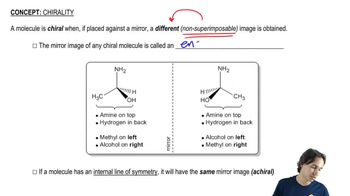
Chirality is a property of a molecule that makes it non-superimposable on its mirror image, much like left and right hands. In organic compounds, chiral centers are typically carbon atoms that are bonded to four distinct substituents. The presence of chiral centers in a molecule significantly increases the number of possible stereoisomers.
Recommended video:
Guided course
05:10
What is chirality?

Calculating Stereoisomers

The number of stereoisomers for a compound can be calculated using the formula 2^n, where n is the number of chiral centers in the molecule. For a ketotriose, which has three carbon atoms and typically one or more chiral centers, this formula helps determine the total possible stereoisomers, considering that each chiral center can exist in two configurations (R or S).
Recommended video:
Guided course
01:58
Determining when molecules are stereoisomers.
Related Practice
Textbook Question

Oxidation of a primary alcohol to an aldehyde usually gives some over-oxidation to the carboxylic acid. Assume you have used PCC to oxidize pentan-1-ol to pentanal.

(a) Show how you would use acid–base extraction to purify the pentanal.

(b) Which of the expected impurities cannot be removed from pentanal by acid–base extractions? How would you remove this impurity?

990
views
Textbook Question

Phenols are less acidic than carboxylic acids, with values of pKa around 10. Phenols are deprotonated by (and therefore soluble in) solutions of sodium hydroxide but not by solutions of sodium bicarbonate. Explain how you would use extractions to isolate the three pure compounds from a mixture of p-cresol (p-methylphenol), cyclohexanone, and benzoic acid.

2320
views
Textbook Question

Show how you would synthesize the following carboxylic acids, using the indicated starting materials.

(a) oct-4-yne → butanoic acid

(b) trans-cyclodecene → decanedioic acid

763
views
Textbook Question

Write the mechanism for the base-catalyzed conversion of D-fructose to D-glucose and D-mannose.

1104
views
Textbook Question

The IR spectrum of trans-oct-2-enoic acid is shown. Point out the spectral characteristics that allow you to tell that this is a carboxylic acid, and show which features lead you to conclude that the acid is unsaturated and conjugated.

<IMAGE>

1835
views
Textbook Question

Show how you would synthesize the following carboxylic acids, using the indicated starting materials.

(d) butan-2-ol → 2-methylbutanoic acid

665
views