
Ch. 20 - Carboxylic Acids
Wade - Organic Chemistry 9th Edition
Wade9th EditionOrganic ChemistryISBN: 9780135213728Not the one you use?Change textbook
Chapter 20, Problem 6

Oxidation of a primary alcohol to an aldehyde usually gives some over-oxidation to the carboxylic acid. Assume you have used PCC to oxidize pentan-1-ol to pentanal.
(a) Show how you would use acid–base extraction to purify the pentanal.
(b) Which of the expected impurities cannot be removed from pentanal by acid–base extractions? How would you remove this impurity?

Verified step by step guidance
1
Step 1: Understand the reaction. PCC (Pyridinium chlorochromate) is a reagent used to oxidize primary alcohols to aldehydes without further oxidation to carboxylic acids. In this case, pentan-1-ol is oxidized to pentanal.
Step 2: Consider the acid-base extraction process. Acid-base extraction is a technique used to separate compounds based on their acid-base properties. Pentanal is a neutral compound, while any carboxylic acid formed as an impurity would be acidic.
Step 3: Perform the acid-base extraction. Add a dilute aqueous base (e.g., sodium bicarbonate) to the organic layer containing pentanal. The base will react with any carboxylic acid impurities, converting them to their corresponding carboxylate salts, which are water-soluble and can be separated from the organic layer.
Step 4: Identify impurities that cannot be removed by acid-base extraction. Aldehydes can sometimes form hydrates or react with themselves to form dimers or polymers, which are neutral and cannot be removed by acid-base extraction.
Step 5: Remove neutral impurities. To remove these neutral impurities, you can use techniques such as distillation, which separates compounds based on boiling points, or recrystallization if the impurity forms a solid that can be separated from the liquid pentanal.

Verified video answer for a similar problem:

This video solution was recommended by our tutors as helpful for the problem above.
Video duration:
8m
Was this helpful?

Key Concepts

Here are the essential concepts you must grasp in order to answer the question correctly.

Oxidation of Alcohols

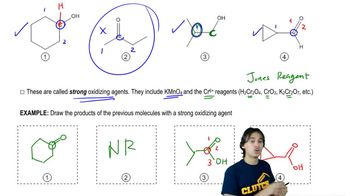
Oxidation of alcohols involves converting a primary alcohol into an aldehyde or further into a carboxylic acid. The reagent PCC (pyridinium chlorochromate) is commonly used to selectively oxidize primary alcohols to aldehydes without over-oxidizing them to carboxylic acids, making it ideal for synthesizing pentanal from pentan-1-ol.
Recommended video:
Guided course
05:53
Strong oxidizing agents

Acid-Base Extraction

Acid-base extraction is a technique used to separate compounds based on their acid-base properties. It involves adding an acid or base to a mixture to convert one component into its ionic form, which is then separated using a solvent. This method can purify pentanal by removing acidic or basic impurities, but neutral impurities may remain.
Recommended video:
Guided course
02:49
The Lewis definition of acids and bases.

Impurity Removal Techniques

Some impurities, such as neutral compounds, cannot be removed by acid-base extraction. To remove these, techniques like distillation or recrystallization may be employed. Distillation separates components based on boiling points, effectively purifying pentanal by isolating it from neutral impurities that do not react in acid-base extractions.
Recommended video:
Guided course
05:41
Reason for Analytical Methods