
Ch. 20 - Carboxylic Acids
Wade - Organic Chemistry 9th Edition
Wade9th EditionOrganic ChemistryISBN: 9780135213728Not the one you use?Change textbook
Chapter 20, Problem 5

Phenols are less acidic than carboxylic acids, with values of pKa around 10. Phenols are deprotonated by (and therefore soluble in) solutions of sodium hydroxide but not by solutions of sodium bicarbonate. Explain how you would use extractions to isolate the three pure compounds from a mixture of p-cresol (p-methylphenol), cyclohexanone, and benzoic acid.

Verified step by step guidance
1
Begin by understanding the acidity of the compounds involved. Phenols, such as p-cresol, have a pKa around 10, making them less acidic than carboxylic acids like benzoic acid, which have a pKa around 4.5. Cyclohexanone is a ketone and does not have acidic properties relevant to this extraction process.
Use a sodium bicarbonate solution to selectively deprotonate and dissolve the benzoic acid. Since benzoic acid is more acidic than p-cresol, it will react with sodium bicarbonate to form a soluble benzoate ion, while p-cresol and cyclohexanone remain in the organic phase.
Separate the aqueous layer containing the benzoate ion from the organic layer. Acidify the aqueous layer with hydrochloric acid to precipitate benzoic acid, which can then be isolated by filtration.
Next, treat the remaining organic layer with sodium hydroxide. This will deprotonate the p-cresol, forming a soluble phenoxide ion, while cyclohexanone remains in the organic phase.
Separate the aqueous layer containing the phenoxide ion from the organic layer. Acidify the aqueous layer with hydrochloric acid to precipitate p-cresol, which can be isolated by filtration. The remaining organic layer contains cyclohexanone, which can be isolated by evaporation or distillation.

Verified video answer for a similar problem:

This video solution was recommended by our tutors as helpful for the problem above.
Video duration:
6m
Was this helpful?

Key Concepts

Here are the essential concepts you must grasp in order to answer the question correctly.

Acid-Base Extraction

Acid-base extraction is a technique used to separate compounds based on their acid-base properties. By adjusting the pH of the solution, different compounds can be selectively deprotonated or protonated, making them soluble in either the aqueous or organic phase. This method is particularly useful for separating acidic, basic, and neutral compounds in a mixture.
Recommended video:
Guided course
02:49
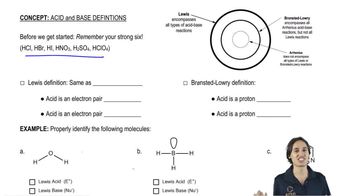
The Lewis definition of acids and bases.

pKa and Acidity

The pKa value of a compound indicates its acidity, with lower pKa values corresponding to stronger acids. Phenols, with a pKa around 10, are weaker acids compared to carboxylic acids, which have pKa values around 4-5. This difference in acidity allows for selective deprotonation using bases of varying strength, such as sodium hydroxide for phenols and sodium bicarbonate for carboxylic acids.
Recommended video:
Guided course
07:45
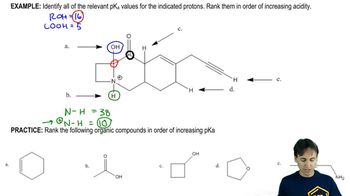
Identifying pKa values

Solubility and Deprotonation

Solubility in aqueous solutions is influenced by the ionization of compounds. Phenols can be deprotonated by strong bases like sodium hydroxide, making them soluble in water, while weaker bases like sodium bicarbonate are insufficient. Understanding the solubility behavior of compounds in different pH environments is crucial for designing effective extraction procedures to isolate specific components from a mixture.
Recommended video:
Guided course
02:01
Introducing common solvents and other molecules in organic chemistry.