Ch. 20 - Carboxylic Acids
Wade - Organic Chemistry 9th Edition
Wade9th EditionOrganic ChemistryISBN: 9780135213728Not the one you use?Change textbook
Chapter 20, Problem 3c

Rank the compounds in each set in order of increasing acid strength.
(c)

Verified step by step guidance
1
Step 1: Identify the functional group responsible for acidity in all three compounds. Each compound contains a carboxylic acid group (-COOH), which is the acidic functional group.
Step 2: Recognize the role of electronegative substituents (chlorine atoms) in influencing acidity. Electronegative groups increase acidity by stabilizing the conjugate base through inductive effects.
Step 3: Compare the number and position of chlorine atoms in each compound. Compound I has one chlorine atom attached to the alpha-carbon, Compound II has three chlorine atoms attached to the alpha-carbon, and Compound III has one chlorine atom attached to the beta-carbon.
Step 4: Understand the inductive effect. Chlorine atoms closer to the carboxylic acid group exert a stronger inductive effect, stabilizing the conjugate base more effectively and increasing acidity. Alpha-substituted chlorines have a stronger effect than beta-substituted chlorines.
Step 5: Rank the compounds based on the number and position of chlorine atoms. Compound II, with three alpha-chlorines, will be the most acidic. Compound I, with one alpha-chlorine, will be next. Compound III, with one beta-chlorine, will be the least acidic.

Verified video answer for a similar problem:

This video solution was recommended by our tutors as helpful for the problem above.
Video duration:
4m
Was this helpful?

Key Concepts

Here are the essential concepts you must grasp in order to answer the question correctly.

Acidity and pKa

Acidity in organic chemistry refers to the ability of a compound to donate a proton (H+). The strength of an acid is often measured by its pKa value; lower pKa values indicate stronger acids. Understanding the relationship between structure and acidity is crucial, as factors like electronegativity and resonance can significantly influence a compound's ability to release a proton.
Recommended video:
Guided course
07:45
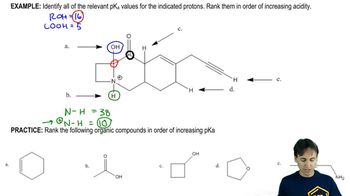
Identifying pKa values

Inductive Effect

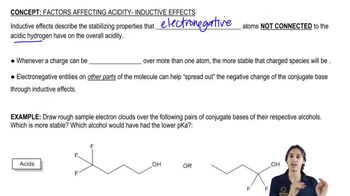
The inductive effect describes how the presence of electronegative atoms or groups can stabilize or destabilize a negative charge in a molecule. In the context of acidity, electron-withdrawing groups (like Cl) can increase acidity by stabilizing the conjugate base through the inductive effect, making it easier for the acid to donate a proton.
Recommended video:
Guided course
01:47
Understanding the Inductive Effect.

Resonance Stabilization

Resonance stabilization occurs when a molecule can be represented by multiple valid Lewis structures, allowing for the delocalization of electrons. In acids, resonance can stabilize the conjugate base formed after deprotonation, enhancing acidity. Compounds with greater resonance stabilization in their conjugate bases tend to be stronger acids.
Recommended video:
Guided course
03:43
The radical stability trend.
Related Practice
Textbook Question

Rank the compounds in each set in order of increasing acid strength.

(a) CH3CH2COOH, CH3CHBrCOOH, CH3CBr2COOH

2154
views
1
rank

Textbook Question

Suppose you have just synthesized heptanoic acid from heptan-1-ol. The product is contaminated by sodium dichromate, sulfuric acid, heptan-1-ol, and possibly heptanal. Explain how you would use acid–base extractions to purify the heptanoic acid. Use a chart, like that in Figure 20-3, to show where the impurities are at each stage.

89
views
Textbook Question

Oxidation of a primary alcohol to an aldehyde usually gives some over-oxidation to the carboxylic acid. Assume you have used PCC to oxidize pentan-1-ol to pentanal.

(a) Show how you would use acid–base extraction to purify the pentanal.

(b) Which of the expected impurities cannot be removed from pentanal by acid–base extractions? How would you remove this impurity?

990
views
Textbook Question

Phenols are less acidic than carboxylic acids, with values of pKa around 10. Phenols are deprotonated by (and therefore soluble in) solutions of sodium hydroxide but not by solutions of sodium bicarbonate. Explain how you would use extractions to isolate the three pure compounds from a mixture of p-cresol (p-methylphenol), cyclohexanone, and benzoic acid.

2320
views
Textbook Question

Rank the compounds in each set in order of increasing acid strength.

(b) CH3CH2CH2CHBrCOOH, CH3CH2CHBrCH2COOH, CH3CHBrCH2CH2COOH

1449
views
Textbook Question

Name the following carboxylic acids (when possible, give both a common name and a systematic name).

(d)

(e)

(f)

709
views