Ch. 20 - Carboxylic Acids
Wade - Organic Chemistry 9th Edition
Wade9th EditionOrganic ChemistryISBN: 9780135213728Not the one you use?Change textbook
Chapter 20, Problem 18b

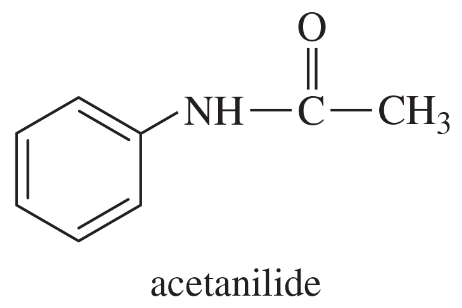
Show how to synthesize the following compounds, using appropriate carboxylic acids and amines.
(b)

Verified step by step guidance
1
Step 1: Identify the target compound, acetanilide, which is an amide formed from the reaction between a carboxylic acid derivative and an amine. The structure contains an acetamide group (-CONH-) attached to a phenyl ring.
Step 2: Select the appropriate carboxylic acid derivative. In this case, acetic acid (CH₃COOH) or its derivative, such as acetic anhydride (CH₃CO)₂O, can be used as the source of the acetyl group (-COCH₃).
Step 3: Choose the amine required for the synthesis. Aniline (C₆H₅NH₂), which contains a phenyl group attached to an amino group (-NH₂), is the appropriate amine for this reaction.
Step 4: Perform the reaction. React aniline (C₆H₅NH₂) with acetic anhydride (CH₃CO)₂O under mild conditions. The acetic anhydride will transfer the acetyl group to the amine, forming acetanilide and acetic acid as a byproduct.
Step 5: Purify the product. After the reaction, isolate acetanilide by recrystallization or other purification techniques to obtain the pure compound.

Verified video answer for a similar problem:

This video solution was recommended by our tutors as helpful for the problem above.
Video duration:
4m
Was this helpful?

Key Concepts

Here are the essential concepts you must grasp in order to answer the question correctly.

Carboxylic Acids

Carboxylic acids are organic compounds characterized by the presence of a carboxyl group (-COOH). They are important in organic synthesis as they can react with amines to form amides. Understanding the reactivity and properties of carboxylic acids is crucial for synthesizing compounds like acetanilide, where a carboxylic acid is used to introduce the carbonyl functionality.
Recommended video:
Guided course
04:20
Carboxylic Acids Nomenclature

Amines

Amines are organic compounds derived from ammonia by replacing one or more hydrogen atoms with alkyl or aryl groups. They can act as nucleophiles in chemical reactions, making them essential in the formation of amides. In the synthesis of acetanilide, an amine (aniline) reacts with an acyl chloride or carboxylic acid to form the desired product, highlighting the role of amines in organic synthesis.
Recommended video:
Guided course
07:12
Reductive Amination

Amide Formation

Amide formation is a key reaction in organic chemistry where a carboxylic acid reacts with an amine to produce an amide and water. This reaction is fundamental in the synthesis of various organic compounds, including pharmaceuticals. In the case of acetanilide, the reaction between acetic acid and aniline exemplifies this process, showcasing how functional groups can be transformed to create more complex molecules.
Recommended video:
Guided course
01:33
Amide Nomenclature