Ch. 20 - Carboxylic Acids
Wade - Organic Chemistry 9th Edition
Wade9th EditionOrganic ChemistryISBN: 9780135213728Not the one you use?Change textbook
Chapter 20, Problem 19

Show how you would synthesize the following compounds from the appropriate carboxylic acids or acid derivatives.

Verified step by step guidance
1
Step 1: For compound A, identify the target structure as a cyclopentylpropanoic acid. Start with cyclopentane and introduce a propanoic acid group using a Friedel-Crafts acylation reaction with propanoyl chloride (CH3CH2COCl) in the presence of AlCl3.
Step 2: For compound B, identify the target structure as a cyclopentenyl aldehyde. Begin with cyclopentene and perform hydroformylation using CO and H2 in the presence of a rhodium catalyst to introduce the aldehyde group.
Step 3: For compound C, identify the target structure as a cyclohexylpropanoic acid. Start with cyclohexane and introduce a propanoic acid group using a Friedel-Crafts acylation reaction with propanoyl chloride (CH3CH2COCl) in the presence of AlCl3.
Step 4: Ensure that the reaction conditions for each synthesis are optimized to avoid overreaction or side products. For example, use stoichiometric amounts of reagents and control temperature during the reactions.
Step 5: Purify the synthesized compounds using techniques such as recrystallization or distillation to isolate the desired product and confirm the structure using spectroscopic methods like NMR or IR.

Verified video answer for a similar problem:

This video solution was recommended by our tutors as helpful for the problem above.
Video duration:
8m
Was this helpful?

Key Concepts

Here are the essential concepts you must grasp in order to answer the question correctly.

Carboxylic Acids and Derivatives

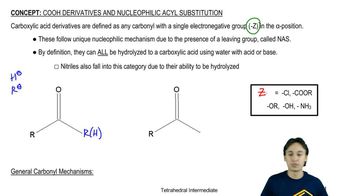
Carboxylic acids are organic compounds containing a carboxyl group (-COOH), which is crucial for various chemical reactions. Acid derivatives, such as esters, amides, and anhydrides, can be synthesized from carboxylic acids and are often more reactive. Understanding the reactivity and transformation of these compounds is essential for designing synthetic pathways to target molecules.
Recommended video:
Guided course
03:50
Intro to Carboxylic Acid Derivatives

Functional Group Transformations

Functional group transformations involve converting one functional group into another through chemical reactions. This concept is vital in organic synthesis, as it allows chemists to modify the structure and properties of molecules. For example, converting a carboxylic acid to an alcohol or an ester can be achieved through specific reagents and reaction conditions, which are key to synthesizing the desired compounds A, B, and C.
Recommended video:
Guided course
02:36
Identifying Functional Groups

Synthesis Strategies

Synthesis strategies refer to the systematic approach used to construct complex organic molecules from simpler precursors. This includes selecting appropriate starting materials, reaction conditions, and reagents to achieve the desired transformations. In the context of the question, identifying the correct carboxylic acids or derivatives to synthesize compounds A, B, and C requires a clear understanding of retrosynthetic analysis and the reactivity of functional groups.
Recommended video:
1:16
Synthesis of Amino Acids: Strecker Synthesis Example 1