Ch. 20 - Carboxylic Acids
Wade - Organic Chemistry 9th Edition
Wade9th EditionOrganic ChemistryISBN: 9780135213728Not the one you use?Change textbook
Chapter 20, Problem 18a

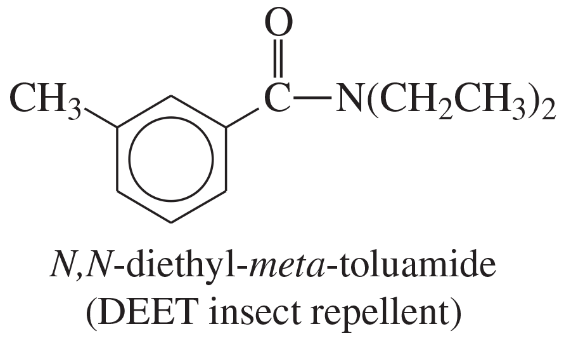
Show how to synthesize the following compounds, using appropriate carboxylic acids and amines.
(a)

Verified step by step guidance
1
Step 1: Identify the functional groups in the target molecule, DEET. It contains an amide functional group (-CONR2) attached to a benzene ring with a methyl substituent in the meta position.
Step 2: Select the appropriate carboxylic acid precursor. The carboxylic acid should have the benzene ring with a methyl group in the meta position relative to the carboxylic acid group. This compound is meta-toluic acid (C8H8O2).
Step 3: Choose the amine precursor. The amine required is diethylamine (CH3CH2)2NH, as the amide group in DEET contains two ethyl groups attached to the nitrogen atom.
Step 4: Perform the synthesis reaction. React meta-toluic acid with diethylamine in the presence of a dehydrating agent such as dicyclohexylcarbodiimide (DCC) or by using acid chloride formation followed by amine addition. This will result in the formation of the amide bond.
Step 5: Purify the product. Use techniques such as recrystallization or chromatography to isolate and purify the synthesized DEET compound.

Verified video answer for a similar problem:

This video solution was recommended by our tutors as helpful for the problem above.
Video duration:
4m
Was this helpful?

Key Concepts

Here are the essential concepts you must grasp in order to answer the question correctly.

Carboxylic Acids

Carboxylic acids are organic compounds characterized by the presence of a carboxyl group (-COOH). They are important in organic synthesis as they can react with amines to form amides. Understanding the reactivity and properties of carboxylic acids is crucial for synthesizing compounds like DEET, where the carboxylic acid serves as a precursor in the formation of the amide bond.
Recommended video:
Guided course
04:20
Carboxylic Acids Nomenclature

Amines

Amines are organic compounds derived from ammonia by replacing one or more hydrogen atoms with alkyl or aryl groups. They can act as nucleophiles in chemical reactions, particularly in the formation of amides from carboxylic acids. In the synthesis of DEET, the amine component is essential for creating the desired structure and functionality of the insect repellent.
Recommended video:
Guided course
07:12
Reductive Amination

Amide Formation

Amide formation is a key reaction in organic chemistry where a carboxylic acid reacts with an amine to produce an amide and water. This reaction is significant in the synthesis of various compounds, including pharmaceuticals and agrochemicals. In the case of DEET, understanding the mechanism of amide formation helps in designing the synthesis pathway and optimizing reaction conditions.
Recommended video:
Guided course
01:33
Amide Nomenclature
Related Practice
Textbook Question

Show how to synthesize the following compounds, using appropriate carboxylic acids and amines.

(b)

665
views

Textbook Question

Show how you would synthesize the following compounds from the appropriate carboxylic acids or acid derivatives.

1339
views
Textbook Question

The mechanism of the Fischer esterification was controversial until 1938, when Irving Roberts and Harold Urey of Columbia University used isotopic labeling to follow the alcohol oxygen atom through the reaction. A catalytic amount of sulfuric acid was added to a mixture of 1 mole of acetic acid and 1 mole of special methanol containing the heavy 18O isotope of oxygen. After a short period, the acid was neutralized to stop the reaction, and the components of the mixture were separated.

(a) Propose a mechanism for this reaction.

(b) Follow the labeled 18O atom through your mechanism, and show where it is found in the products.

951
views
Textbook Question

(b) Finish the solution for Solved Problem 20-1 by providing a mechanism for the acid-catalyzed hydrolysis of ethyl formate.

929
views
Textbook Question

The given was missing some important resonance forms of the intermediates shown in brackets. Complete this mechanism by drawing all the resonance forms of these intermediates. Do your resonance forms help to explain why this reaction occurs under very mild conditions (water with a tiny trace of acid)?

1016
views
Textbook Question

Show how to synthesize the following compounds, using appropriate carboxylic acids and amines.

(c)

616
views