Ch. 22 - Condensations and Alpha Substitutions of Carbonyl Compounds
Wade - Organic Chemistry 9th Edition
Wade9th EditionOrganic ChemistryISBN: 9780135213728Not the one you use?Change textbook
Chapter 22, Problem 19c

Give the expected products for the aldol condensations of (c) pentan-3-one.

Verified step by step guidance
1
Identify the alpha-hydrogens in pentan-3-one. Alpha-hydrogens are the hydrogens attached to the carbon atoms adjacent to the carbonyl group. In pentan-3-one, the alpha-hydrogens are on carbons 2 and 4.
Determine the enolate ion formation. Under basic conditions, one of the alpha-hydrogens is removed by a base, forming an enolate ion. The enolate ion is stabilized by resonance between the alpha-carbon and the carbonyl oxygen.
Perform the nucleophilic attack. The enolate ion acts as a nucleophile and attacks the carbonyl carbon of another molecule of pentan-3-one, forming a beta-hydroxyketone intermediate.
Dehydrate the beta-hydroxyketone. Under heating or continued basic conditions, the beta-hydroxyketone undergoes elimination of water (E1cB mechanism), forming an α,β-unsaturated ketone as the final product.
Write the final product structure. The product will be a conjugated enone, specifically 4-methylpent-3-en-2-one, resulting from the aldol condensation of pentan-3-one with itself.

Verified video answer for a similar problem:

This video solution was recommended by our tutors as helpful for the problem above.
Video duration:
6m
Was this helpful?

Key Concepts

Here are the essential concepts you must grasp in order to answer the question correctly.

Aldol Condensation

Aldol condensation is a reaction between aldehydes or ketones that contain alpha-hydrogens, leading to the formation of β-hydroxy carbonyl compounds (aldols) followed by dehydration to yield α,β-unsaturated carbonyl compounds. This reaction is significant in organic synthesis as it allows for the formation of larger carbon skeletons and introduces functional groups.
Recommended video:
Guided course
09:51
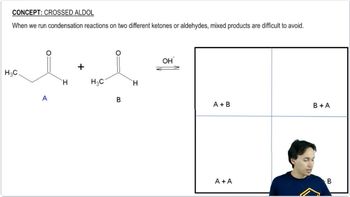
Crossed Aldol

Enolate Ion Formation

In aldol condensation, the first step involves the formation of an enolate ion from a carbonyl compound, which occurs when a base abstracts an alpha-hydrogen. This enolate ion acts as a nucleophile, attacking the carbonyl carbon of another molecule, leading to the formation of the aldol product. Understanding this step is crucial for predicting the products of the reaction.
Recommended video:
Guided course
02:26
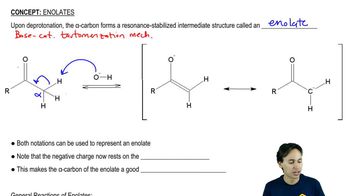
Formation of Enolates

Dehydration Reaction

After the aldol product is formed, it can undergo dehydration, where a molecule of water is eliminated, resulting in the formation of an α,β-unsaturated carbonyl compound. This step is essential as it stabilizes the product and enhances its reactivity, making it a key feature of aldol condensations. Recognizing the conditions that favor dehydration is important for predicting the final products.
Recommended video:
Guided course
01:23
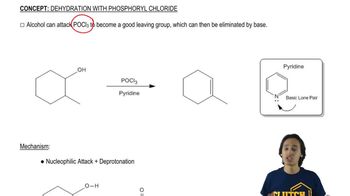
General Reaction of Dehydration with POCl3