Ch. 22 - Condensations and Alpha Substitutions of Carbonyl Compounds
Wade - Organic Chemistry 9th Edition
Wade9th EditionOrganic ChemistryISBN: 9780135213728Not the one you use?Change textbook
Chapter 22, Problem 22a,b

Propose a mechanism for the dehydration of diacetone alcohol to mesityl oxide
(a) in acid.
(b) in base.

Verified step by step guidance
1
Step 1: (Acidic conditions) Begin by protonating the hydroxyl group (-OH) of diacetone alcohol using the acid catalyst. This increases the electrophilicity of the oxygen atom and makes the molecule more susceptible to elimination.
Step 2: (Acidic conditions) After protonation, the molecule undergoes an E1 elimination mechanism. The protonated hydroxyl group leaves as water (H₂O), forming a carbocation intermediate.
Step 3: (Acidic conditions) The carbocation intermediate undergoes rearrangement or stabilization, if necessary, and a proton is removed from the adjacent carbon atom (α-carbon) by the conjugate base of the acid. This results in the formation of a double bond, yielding mesityl oxide.
Step 4: (Basic conditions) In basic conditions, the base abstracts a proton from the α-carbon adjacent to the hydroxyl group of diacetone alcohol, forming an enolate ion. This step initiates the E2 elimination mechanism.
Step 5: (Basic conditions) The enolate ion facilitates the elimination of the hydroxyl group (-OH) as water (H₂O), forming a double bond between the α-carbon and β-carbon, resulting in mesityl oxide.

Verified video answer for a similar problem:

This video solution was recommended by our tutors as helpful for the problem above.
Video duration:
5m
Was this helpful?

Key Concepts

Here are the essential concepts you must grasp in order to answer the question correctly.

Dehydration Reaction

Dehydration reactions involve the removal of a water molecule from a compound, often resulting in the formation of a double bond. In organic chemistry, this process is crucial for converting alcohols into alkenes or other unsaturated compounds. Understanding the conditions under which dehydration occurs, such as acidic or basic environments, is essential for predicting the products and mechanisms involved.
Recommended video:
Guided course
01:23
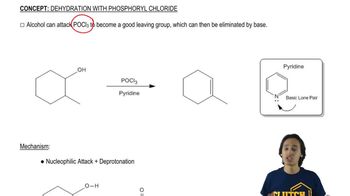
General Reaction of Dehydration with POCl3

Acid-Catalyzed Mechanism

In acid-catalyzed dehydration, the alcohol is protonated by an acid, increasing its electrophilicity. This leads to the formation of a carbocation intermediate, which can then lose a water molecule to form a double bond. The stability of the carbocation and the ability to rearrange can significantly influence the reaction pathway and the final product, such as mesityl oxide in this case.
Recommended video:
Guided course
06:34
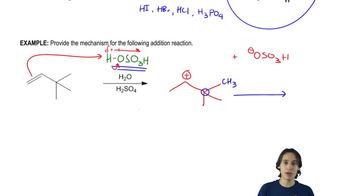
Acid-catalyzed hydration mechanism

Base-Catalyzed Mechanism

In base-catalyzed dehydration, a base abstracts a proton from the alcohol, generating an alkoxide ion that can eliminate a water molecule. This mechanism typically involves a concerted process where the bond formation and bond breaking occur simultaneously, leading to the formation of an alkene. The choice of base and the reaction conditions can affect the efficiency and selectivity of the dehydration process.
Recommended video:
Guided course
01:57
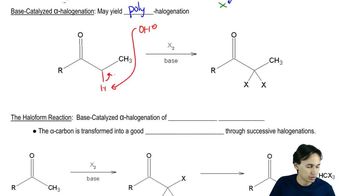
Base Catalyzed