Ch. 22 - Condensations and Alpha Substitutions of Carbonyl Compounds
Wade - Organic Chemistry 9th Edition
Wade9th EditionOrganic ChemistryISBN: 9780135213728Not the one you use?Change textbook
Chapter 22, Problem 24a

Predict the products of aldol condensation, followed by dehydration, of the following ketones and aldehydes.
(a) butyraldehyde

Verified step by step guidance
1
Identify the reactants: Butyraldehyde (CH₃CH₂CH₂CHO) is an aldehyde with an alpha-hydrogen, making it capable of undergoing aldol condensation.
Determine the enolate formation: In the presence of a base (e.g., OH⁻), the alpha-hydrogen of butyraldehyde is abstracted, forming an enolate ion. The enolate ion is a nucleophile.
Perform the aldol addition: The enolate ion attacks the carbonyl carbon of another butyraldehyde molecule, forming a β-hydroxyaldehyde intermediate. The structure of this intermediate is CH₃CH₂CH(OH)CH₂CHO.
Carry out the dehydration step: Under heating or in the presence of a strong base, the β-hydroxyaldehyde undergoes elimination of water (dehydration) to form an α,β-unsaturated aldehyde. The product is crotonaldehyde (CH₃CH=CHCHO).
Summarize the reaction: The overall reaction involves the formation of crotonaldehyde as the final product through aldol condensation and subsequent dehydration of butyraldehyde.

Verified video answer for a similar problem:

This video solution was recommended by our tutors as helpful for the problem above.
Video duration:
6m
Was this helpful?

Key Concepts

Here are the essential concepts you must grasp in order to answer the question correctly.

Aldol Condensation

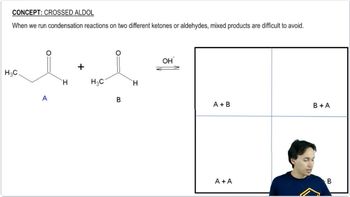
Aldol condensation is a reaction between aldehydes or ketones that contain at least one alpha-hydrogen. In this process, one molecule acts as a nucleophile and attacks the carbonyl carbon of another molecule, forming a beta-hydroxy aldehyde or ketone. This intermediate can then undergo dehydration to yield an α,β-unsaturated carbonyl compound, which is often the final product of the reaction.
Recommended video:
Guided course
09:51
Crossed Aldol

Dehydration Reaction

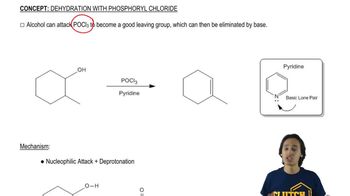
Dehydration is the process of removing a water molecule from a compound. In the context of aldol condensation, after the formation of the beta-hydroxy carbonyl compound, dehydration occurs, leading to the formation of a double bond between the alpha and beta carbons. This step is crucial as it stabilizes the product and enhances its reactivity, often resulting in conjugated systems that are more favorable in organic reactions.
Recommended video:
Guided course
01:23
General Reaction of Dehydration with POCl3

Alpha-Hydrogen

Alpha-hydrogens are the hydrogen atoms attached to the carbon atom adjacent to a carbonyl group (C=O) in aldehydes and ketones. The presence of alpha-hydrogens is essential for aldol condensation, as they can be abstracted by a base to form an enolate ion, which is a key intermediate in the reaction. The ability to form enolates is what allows these compounds to participate in nucleophilic addition reactions.
Recommended video:
Guided course
00:48
The definition of hydrogenation.