Which of the D-aldopentoses will give optically active aldaric acids on oxidation with HNO3?
Ch. 23 - Carbohydrates and Nucleic Acids
Chapter 23, Problem 58
An unknown reducing disaccharide is found to be unaffected by invertase enzymes. Treatment with an α-galactosidase cleaves the disaccharide to give one molecule of D-fructose and one molecule of D-galactose. When the disaccharide is treated with excess iodomethane and silver oxide and then hydrolyzed in dilute acid, the products are 2,3,4,6-tetra-O-methylgalactose and 1,3,4-tri-O-methylfructose. Propose a structure for this disaccharide, and give its complete systematic name.
Verified step by step guidance1
Analyze the problem: The disaccharide is a reducing sugar, meaning it has a free anomeric carbon capable of acting as a reducing agent. It is unaffected by invertase, which suggests it is not a sucrose-like disaccharide. Treatment with α-galactosidase cleaves the disaccharide, indicating the presence of an α-galactosidic bond.
Examine the cleavage products: The disaccharide is cleaved into D-fructose and D-galactose. This indicates that the disaccharide is composed of these two monosaccharides, with D-galactose linked to D-fructose via an α-galactosidic bond.
Interpret the methylation data: After methylation with iodomethane and silver oxide, followed by hydrolysis, the products are 2,3,4,6-tetra-O-methylgalactose and 1,3,4-tri-O-methylfructose. This suggests that the hydroxyl groups at these positions were originally free and not involved in glycosidic bonds.
Determine the glycosidic linkage: The methylation data indicates that the anomeric carbon of D-galactose is involved in the glycosidic bond (since it is not methylated), and the hydroxyl group at position 2 of D-fructose is also involved in the bond. This points to an α-(1→2) glycosidic linkage between D-galactose and D-fructose.
Propose the structure and name: Based on the above analysis, the disaccharide is α-D-galactopyranosyl-(1→2)-D-fructose. This systematic name reflects the α-galactosidic bond and the connection between the two monosaccharides.

Verified video answer for a similar problem:
This video solution was recommended by our tutors as helpful for the problem above.
Video duration:
13mWas this helpful?
Key Concepts
Here are the essential concepts you must grasp in order to answer the question correctly.
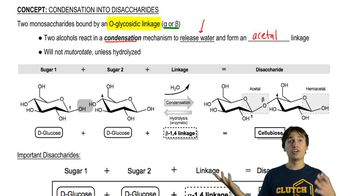
Disaccharides
Disaccharides are carbohydrates composed of two monosaccharide units linked by a glycosidic bond. Understanding the structure and properties of disaccharides is crucial for identifying their components and behavior in chemical reactions. In this case, the disaccharide is reducing, which means it has a free anomeric carbon that can participate in redox reactions.
Recommended video:
Guided course
Disaccharide
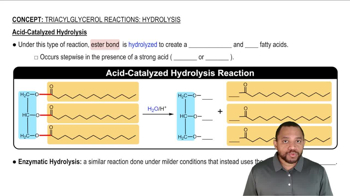
Enzymatic Hydrolysis
Enzymatic hydrolysis involves the breakdown of complex carbohydrates into simpler sugars through the action of specific enzymes. In this question, the disaccharide is unaffected by invertase, indicating that it does not contain a free reducing end that invertase can act upon. The action of α-galactosidase suggests the presence of a galactose unit in the disaccharide.
Recommended video:
Triacylglycerol Reactions: Hydrolysis Concept 3
Methylation and Hydrolysis
Methylation is a chemical reaction that introduces methyl groups into a molecule, often used to protect hydroxyl groups in sugars. The treatment with iodomethane and silver oxide followed by hydrolysis indicates that the hydroxyl groups of the sugars are being converted to methyl ethers, which helps in determining the structure of the original disaccharide. The resulting methylated products provide insight into the arrangement of the sugar units.
Recommended video:
Hydrolysis of Thioesters Concept 2
Related Practice
Textbook Question
858
views
Textbook Question
Which of the following sugars are reducing sugars? Which ones would undergo mutarotation?
(c) 6-O-(β-D-galactopyranosyl)-D-glucopyranose
551
views
Textbook Question
Sugar X is known to be a D-aldohexose. On oxidation with HNO3, X gives an optically inactive aldaric acid. When X is degraded to an aldopentose, oxidation of the aldopentose gives an optically active aldaric acid. Determine the structure of X.
937
views
Textbook Question
Which of the following sugars are reducing sugars? Which ones would undergo mutarotation?
(b) α-D-fructofuranosyl-β-D-mannopyranoside
517
views
Textbook Question
Which of the D-aldotetroses will give optically active aldaric acids on oxidation with HNO3?
937
views
Textbook Question
Which of the following sugars are reducing sugars? Which ones would undergo mutarotation?
(a) 4-O-(α-D-glucopyranosyl)-D-galactopyranose
576
views