
Textbook Question
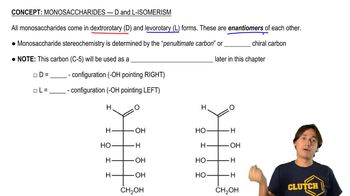
Which of the D-aldopentoses will give optically active aldaric acids on oxidation with HNO3?
858
views

 Verified step by step guidance
 06:47
06:47
 08:17
08:17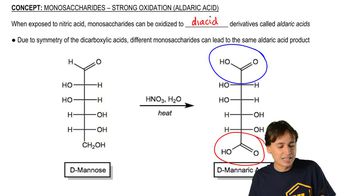 03:10
03:10Which of the D-aldopentoses will give optically active aldaric acids on oxidation with HNO3?
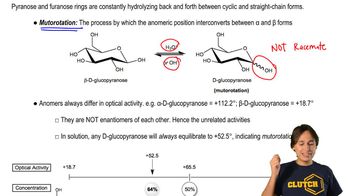
Which of the following sugars are reducing sugars? Which ones would undergo mutarotation?
(c) 6-O-(β-D-galactopyranosyl)-D-glucopyranose
Sugar X is known to be a D-aldohexose. On oxidation with HNO3, X gives an optically inactive aldaric acid. When X is degraded to an aldopentose, oxidation of the aldopentose gives an optically active aldaric acid. Determine the structure of X.
An unknown reducing disaccharide is found to be unaffected by invertase enzymes. Treatment with an α-galactosidase cleaves the disaccharide to give one molecule of D-fructose and one molecule of D-galactose. When the disaccharide is treated with excess iodomethane and silver oxide and then hydrolyzed in dilute acid, the products are 2,3,4,6-tetra-O-methylgalactose and 1,3,4-tri-O-methylfructose. Propose a structure for this disaccharide, and give its complete systematic name.
Even though sugar X gives an optically inactive aldaric acid, the pentose formed by degradation gives an optically active aldaric acid. Does this finding contradict the principle that optically inactive reagents cannot form optically active products?
Show what product results if the aldopentose formed from degradation of X is further degraded to an aldotetrose. Does HNO3 oxidize this aldotetrose to an optically active aldaric acid?