
Textbook Question
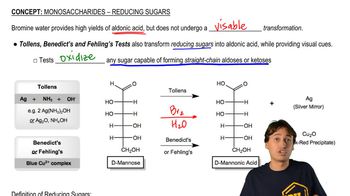
Which of the D-aldopentoses will give optically active aldaric acids on oxidation with HNO3?
858
views

 Verified step by step guidance
 08:42
08:42
 03:06
03:06 06:00
06:00Which of the D-aldopentoses will give optically active aldaric acids on oxidation with HNO3?
Which of the following sugars are reducing sugars? Which ones would undergo mutarotation?
(a) methyl β-D-glucopyranoside
(b) 2,3,4,6-tetra-O-methyl-D-mannopyranose
(c) 1,3,6-tri-O-methyl-D-fructofuranose
(d) methyl 2,3,4,6-tetra-O-methyl-β-D-galactopyranoside
Which of the following sugars are reducing sugars? Which ones would undergo mutarotation?
(b) α-D-fructofuranosyl-β-D-mannopyranoside
An unknown reducing disaccharide is found to be unaffected by invertase enzymes. Treatment with an α-galactosidase cleaves the disaccharide to give one molecule of D-fructose and one molecule of D-galactose. When the disaccharide is treated with excess iodomethane and silver oxide and then hydrolyzed in dilute acid, the products are 2,3,4,6-tetra-O-methylgalactose and 1,3,4-tri-O-methylfructose. Propose a structure for this disaccharide, and give its complete systematic name.
Which of the D-aldotetroses will give optically active aldaric acids on oxidation with HNO3?
Which of the following sugars are reducing sugars? Which ones would undergo mutarotation?
(a) 4-O-(α-D-glucopyranosyl)-D-galactopyranose