
Ch. 24 - Amino Acids, Peptides, and Proteins
Wade - Organic Chemistry 9th Edition
Wade9th EditionOrganic ChemistryISBN: 9780135213728Not the one you use?Change textbook
Chapter 24, Problem 1b

Draw three-dimensional representations of the following amino acids.
(b) L-histidine

Verified step by step guidance
1
Understand the structure of L-histidine: L-histidine is an amino acid with a central alpha-carbon bonded to four groups: an amino group (-NH₂), a carboxyl group (-COOH), a hydrogen atom, and an imidazole side chain (a five-membered ring containing two nitrogen atoms). The 'L' designation indicates the stereochemistry, meaning the amino group is on the left in a Fischer projection.
Place the alpha-carbon at the center of your 3D representation. Attach the amino group (-NH₂) to the left, the carboxyl group (-COOH) to the right, the hydrogen atom pointing backward (into the plane), and the imidazole side chain pointing forward (out of the plane). This arrangement follows the standard convention for L-amino acids.
Draw the imidazole side chain in detail: The imidazole ring is a five-membered heterocyclic ring with two nitrogen atoms. One nitrogen is part of a double bond, and the other has a lone pair of electrons. Ensure the ring is planar and properly connected to the alpha-carbon.
Indicate the stereochemistry: Use wedge-and-dash notation to show the 3D orientation of the groups around the alpha-carbon. The wedge represents the group coming out of the plane (toward the viewer), and the dash represents the group going into the plane (away from the viewer).
Label all functional groups and atoms clearly: Ensure the amino group, carboxyl group, hydrogen, and imidazole side chain are labeled. Verify that the structure adheres to the correct stereochemistry for L-histidine.

Verified video answer for a similar problem:

This video solution was recommended by our tutors as helpful for the problem above.
Video duration:
2m
Was this helpful?

Key Concepts

Here are the essential concepts you must grasp in order to answer the question correctly.

Amino Acid Structure

Amino acids are organic compounds that serve as the building blocks of proteins. Each amino acid consists of a central carbon atom (the alpha carbon) bonded to an amino group (-NH2), a carboxyl group (-COOH), a hydrogen atom, and a variable side chain (R group) that determines the specific properties of the amino acid. Understanding this structure is essential for drawing accurate three-dimensional representations.
Recommended video:
Guided course
11:14
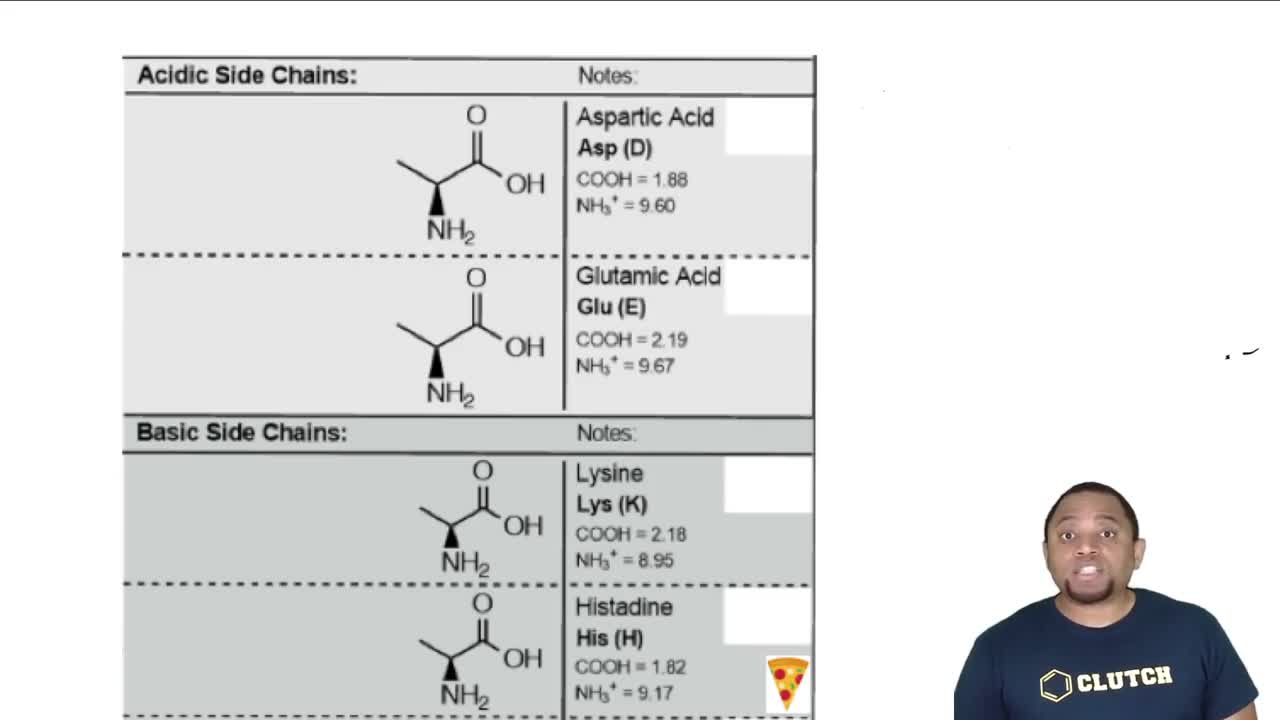
Charged Amino Acids

Chirality in Amino Acids

Most amino acids, except glycine, are chiral, meaning they exist in two enantiomeric forms that are mirror images of each other. The 'L' and 'D' designations refer to the orientation of the amino group in relation to the carboxyl group. For l-histidine, it is crucial to represent the correct stereochemistry in three-dimensional models, as this affects the amino acid's biological function.
Recommended video:
Guided course
09:36
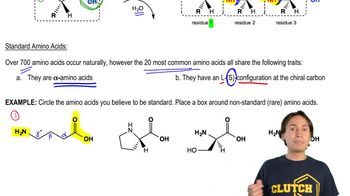
Standard Amino Acids

Three-Dimensional Molecular Representation

Three-dimensional representations of molecules, such as amino acids, can be depicted using various models, including ball-and-stick and space-filling models. These representations help visualize the spatial arrangement of atoms and the overall shape of the molecule, which is important for understanding interactions in biological systems. For l-histidine, accurately depicting its side chain and functional groups is key to illustrating its role in protein structure.
Recommended video:
Guided course
07:44
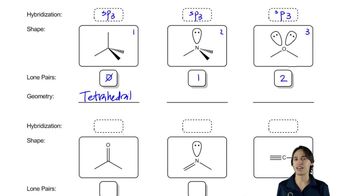
Molecular Geometry Explained.